


There’s been quite a ruckus over a news story stating that the Oxford School District was considering the creation of a separate opt-in school, or school-within-a-school, for students on the federal school-lunch program in an effort to reduce the school's achievement gap.
The Oxford School Board held a special meeting Friday, Sept. 30, to address community concerns, and released a press release apologizing, and stating that no separate school would be formed.
The separate academy idea might be a good one for a district with 20,000 students. For a district with 4,000 it just doesn't work for a variety of reasons. I won’t address some of the comments made by Superintendent Bryan Harvey, save to say that they weren’t very well thought out. However ham-handed some of Harvey’s comments might have been, he and the school board do deserve credit for trying to provide the best education possible for every Oxford student. Their heart was in the right place even if their head wasn't.
There is a huge socio-economic divide in the Oxford student body; although located in the poorest state in the nation, the median price for houses listed for sale in Oxford is almost $250,000. I suspect the disparities of wealth, which often fall along racial lines, cause some real problems when it comes to school management.
Although the proposed academy was presented as a way to help low-income students, in reality it was almost certainly designed to reduce Oxford’s racial achievement gap, which is the largest in the state. Last month the high school gave the school board the results of the junior ACT tests, which all students now take; the school ACT average was 22.2; white students had an average ACT score of 24.6 while black students had an average score of 18.1, which was a substantial increase from the year before. On its face this is a huge achievement gap, but when you analyze the reasons for the difference, these numbers are easily explained, and should be a source of great pride for Oxford.
Oxford has has a tremendous number of near-geniuses; the school’s top quintile is probably equal to any school in the nation, including highly selective schools such as Stuyvesant, the Phillips schools, etc. Oxford is a medical, legal, and academic center, and as such attracts a large number of professionals, researchers, and college professors, along with their children. Most of these affluent, advanced-degree-holders are white or Asian. No matter where you are in the country, children of wealthy professionals or college professors tend to do very well academically. There is nothing that any school can do that will allow other students to "catch-up" to these students.
Add to this the fact that because of its good schools Oxford has a reputation as a brain-cluster community. Most parents are able to perceive whether their children are far smarter than average at a fairly young age, and quite a number of these parents – overwhelmingly affluent and white – are moving to Oxford specifically to take advantage of Oxford’s quality schools. Again, these students are well ahead of the game when they move into the system. There is nothing the district can do that will cause other students to "catch-up" with them.
All of these factors distort Oxford’s achievement gap. If you take out the disproportionate number of children of advanced-degree holders, much of the achievement gap simply disappears. Once you do this you can focus on something else, namely that based on 2016 ACT scores Oxford apparently does an outstanding job of educating its minority students.
According to charts provided by the ACT, a score of 18 is in the 71st percentile in comparison to black students nationally. In Mississippi, the average black student ACT score is 16.6 while the average white score is 20.8. In other words, Oxford, with last year's average black ACT score of 18.1, is doing an outstanding job of educating its minority students in comparison to other Mississippi school districts, at least insofar as the Class of 2016 is concerned.
I've tried to find the ACT average for black students at other Mississippi schools, but Oxford is one of the few school districts to have this information available online. It is possible, however, to compare the performance of Oxford's black students to the whole-school average of schools that are made up of 90 percent or more black students. Here are some of those figures: Aberdeen, 16.7; Ashland, 16.3; Clarksdale, 15.1; Greenwood, 15.8; Hazlehurst, 15.5; Holly Springs, 16.2; Jackson, 15.6; and so on. In fact, a majority of Mississippi school districts have an averageACT score of less than 18.1, regardless of their demographic makeup.
I pointed out some years ago that a good school should cause the student achievement gap to increase every year. That's because such gaps are caused by some students being able to learn more quickly than others, whether due to natural talent or support at home. The only way to reduce such gaps is for a school to simply refuse educational services to its brightest students, which is child abuse. In the fable of The Tortoise and the Hare, the tortoise won the race because the hare took a nap. The only way to narrow achievement gaps is to make the fastest learners take intellectual "naps" by refusing them educational services.
Oxford High School has an incredibly large clump of very high scorers on the ACT every year, and this elite group, made up almost entirely of white and Asian students, causes a huge achievement gap in test scores. But the success of these mostly wealthy, near-genius students doesn't make Oxford's black students any less successful. Yes, there is room for improvement, but in comparison to other districts Oxford's black students are doing well, and the community needs to know that.
The sad fact is that the Oxford School Board was taken in by a bunch of charlatans who convinced them there was a problem when none existed. An achievement gap isn't a problem. If black ACT scores drop back down to the state average, that's a problem.
Showing posts with label Oxford High School. Show all posts
Showing posts with label Oxford High School. Show all posts
Tuesday, October 4, 2016


Sunday, July 3, 2016
Record number and percentage of OHS seniors score 30 or higher on ACT test

According to an ACT score report given to the Oxford School District board by the high school, 39 students from the Class of 2016 scored a 30 or above on the ACT. An additional 10 students scored a 29. This compares to 25 students with a 30 or higher from the Class of 2015, with an additional 10 members of that class scoring a 29.
Some of the increase is due to a larger graduating class. The Class of 2016 had 247 students taking the test, versus 203 from the Class of 2015. But class size doesn't account for all of the increase. 15.8 percent of the Class of 2016 scored at least a 30, versus 12.3 percent for the Class of 2015 and 13.6 percent for the Class of 2014.
 |
| Click to Enlarge |
So why the sudden end to growth for the class of 2021? Well, my theory is that the housing and credit crisis slowed the massive movement of families with young children to Oxford. Subtract 13 from 2021 and you get 2008, the year Easy Money Died.
I find looking at school enrollment numbers interesting, in that you can get a good idea of the overall health of various communities. You can review the Mississippi data for yourself by clicking here.
There are a lot of ways to interpret data, but when a large enrollment increase is accompanied by an ever larger increase in high-end test scores, the most obvious conclusion is that an unusually high number of people moving to Oxford have very bright children. That's a sign of a robust and thriving community. I've referred to this trend in the past as "Brain Clustering."
A score of 30 on the ACT is in the top five percent, so a nationally representative sample of 247 students would have 12 or 13 students with a 30 or higher. With 39 such students, Oxford has three times more very bright students than the national average.
Congratulations are due to a lot of OHS students as well as the high school. May the numbers go ever higher
Saturday, January 30, 2016
Jay Hughes is telegenic, well-spoken, and wrong on almost every issue
Elections have consequences, as they say, and the voters of my district have chosen to elect perhaps the most liberal Democratic member in the state to the legislature. Jay Hughes worked hard to get elected while Brad Mayo ran a lackluster campaign, and from the standpoint of hard work he deserves the job.
Hughes is telegenic and well-spoken, and I believe if he can temper his ultra-liberalism a bit he may become the frontman for the state’s few remaining Democrats. But that doesn’t mean he’s not dead wrong on virtually everything that comes out of his mouth.
Hughes recently posted a Youtube video, which he described as his response to Gov. Phil Bryant’s State of the State Address. Since the entire video is a criticism of Republican policies, I’m going to take the opportunity to respond to Hughes’ issues point by point (I actually agreed on him on one issue!). I’ve posted the video above; by all means view it and make your own judgements
Issue 1: Gov. Bryant has properly used the rainy day fund
Hughes takes issue with Gov. Bryant’s decision to tap into the “rainy day fund” to cover a shortfall in state revenue, since Bryant didn’t want to drain the fund completely dry to fund Initiative 42 or other Democratic spending proposals. Bryant used this fund exactly as it was meant to be used; revenue came up short, and thanks to this fund the state was able to deal with the problem. Perhaps Republicans were foolish in making overly optimistic projections, but they did not budget in advance for this fund to be spent. The Democrats have been chomping at the bit to spend every dime of this money as a general revenue fund. I assume if they have their way and the state comes up short we will just have to file for bankruptcy. This is not responsible government. Thank you Gov. Bryant for using the Rainy Day Fund exactly as it was intended to be used and not allowing it to be plundered by the Democrats.Issue 2: Thanks to Republicans, there are lots of new jobs in our district
Asks Hughes: “Any new jobs around you?” Where have you been Jay Hughes? Thanks to various incentives, Winchester just opened a huge plant in Oxford, employing 1,000 people. Job growth in our district is robust. “Help Wanted” signs are all over town. Yes, there are new jobs around me!Issue 3: Our state's franchise tax is among the nation's highest
Mississippi has one of the highest corporate franchise taxes in the nation. It’s is something that can keep businesses at bay. Believe it or not, corporations look at these things before deciding where to locate their businesses. Right now might or might not be a good time to eliminate this tax, but our goal, as a state, should always to be to have corporate taxes that are lower than any other state in the union. Quit trying to drive away jobs, Jay! Here’s a link that shows how high the Mississippi Franchise tax is in relation to other states. Of course, those states not listed on the attached link don't even have a franchise tax!It should be noted that while some Republican legislators are pushing for a repeal of the franchise tax, Gov. Bryant apparently is not, at least for now. Bryant is pushing for a tax cut for people making under $52,000 a year; hardly the corporate fat-cats described in Hughes' video.
Issue 4: Corporate tax breaks are bringing new jobs and businesses to our state
All of this crap about corporate tax cuts being tax cuts for “their buddies” is just ridiculous. I dare say few state Republicans hang out with the top brass of Nissan, Toyota, Post, Volvo, etc. No tax breaks are provided to any of these people because they are “buddies.” They are provided because they benefit the people of Mississippi by bringing and keeping jobs in our state.For example, in 2002 Mississippi enacted a Freeport Warehouse rule that exempted warehouses which shipped their goods out of state from the personal property inventory tax. This move was not without opposition, and I’m sure Hughes would have been opposed to this “tax break” if he had been in the legislature at that time. Since 2002 Warehouses have sprung up like mad in DeSoto and Marshall County, and the two counties have gone from having almost no warehouses to having more than 50 million square feet, with more coming almost monthly. Businessmen are actually building spec 500,000 sq. ft. warehouses. Volvo recently closed all four of their warehouses around the country and moved and consolidated them in Marshall County. Post Cereal has done the same. These are the types of “cronies” that Hughes wants to keep out of our state.
Well-tailored tax breaks for corporations don’t hurt Mississippians; they help them. We all know that Nissan, Toyota, and Winchester got tax breaks or incentives, and I’m glad they did. Hughes clearly doesn’t want any of this. I guess he wants us all to go back to an era of sharecropping. Well, just no!
Issue 5: Hughes is right, the Democrat should have been seated in District 79
Unless there is something I don’t know, Jay Hughes is absolutely right about House District 79. It seems to me that the Democrat was certified the winner in this race and should have been seated. If the Republican wanted to cite irregularities the proper venue is a circuit court, not through legislative shennanigans. See, everyone can find common ground!Issue 6: As a practical matter we have no inflation; education funding increases are real
Hughes says record education funding doesn't matter due to inflation. This is just a crock! For the last four years the inflation rate has remained under two percent and for the past two has been under one percent. The inflation rate is negligible. Republicans have made real increases in education funding.Issue 7: When properly used, testing is a vital part of the educational process
Hughes says time spent on testing is depriving our children of an education. Tests can certainly be misused and results unfairly used, but frequent testing is an absolute necessity if children are to be educated. Benchmark testing can tell teachers exactly who gets it and who doesn’t, so that children who need help can be identified. Children should be tested on a very regular basis, and every child should receive at least one nationally normed test per year. Testing is wonderful! I suspect Hughes is upset that test results don’t always come out the way ultra-liberal Democrats want them to, but that is no reason to deprive every child of a decent education. Make no mistake, those who attack educational testing are in reality attacking education accountability. Studies show that testing in general reinforces and solidifies learning. Leave our tests alone!Issue 8: Transfering school taxing and spending to the local level is not a bad thing, particularly for Oxford
Hughes says state educational budget cuts may necessitate the raising of local taxes. Well, hallelujah! Anytime we can move taxation from the state to the local level, it’s a good thing. If the state were to cut taxes and quit funding education completely, forcing our local school districts to fund themselves entirely, most citizens would be far better off. The money the state spends is not produced by magic; it comes from taxing our local citizenry. The state funding formula is a complete rip-off for Oxford, and citizens could easily pay the added property taxes out of their savings from a state income tax cut. The lion’s share of local property taxes are paid by commercial businesses, industries, students through their apartment rent, and alumni with pied-à-terres, so shifting the tax burden would greatly benefit Hughes’ constituents at the expense of those rich fat-cats he hates so much.Issue 9: If special needs vouchers help a single student, they are worthwhile
Hughes declares the special needs voucher program an “abject failure” because only 250 were approved and only 107 of these were actually accepted into private schools, which he accused of “cherry picking.” How if this a failure? One hundred seven students were able to get a better educational placement. Hughes wants to subject them to a life of slavery. If only one special needs student was helped the program is worthwhile. Why is it wrong to help people?Issue 10: Americans and Mississippians deserve a say in how they receive their government-funded or subsidized education
I’m not gong to argue about school choice at length, save to say that there ought to be a way to allow citizens school choice while still protecting local school districts. Surely there has to be a way for everyone to come out a winner on this issue! Perhaps a student who opts out of a local school district should get a voucher for 60 or 70 percent of the funding that would be spent on him while the remainder would remain in his assigned district. And by the way, the government DOES give people a choice of where to spend tax dollars, whether it be through food stamps, Medicare, Medicaid, Pell grants, or a host of other programs. The idea that students should be forced to attend a school not of their choosing is, quite plainly, un-American.Issue 11: Hughes fails to recognize that Mississippi has some of the best schools in the nation
Hughes says that tax breaks don’t attract businesses, good schools do. Actually both play a role. But Hughes fails to recognize that Mississippi already has some of the best schools in the nation, one of which is in the very district he represents.Oxford High School students annually post extraordinarily high ACT scores, with 12 to 14 percent of each class scoring 30 or higher, compared to a national average of about five to six percent. In 2013 and 2014 eight Oxford students, or about 3.5 percent of the class, scored a 35 or 36 on the ACT. The national average? About half of one percent. Oxford offers four foreign languages and a host of AP classes.
Of course, there’s more to life than academics. The Oxford school orchestra has made great strides in the past few years. I was really impressed at their last concert. You can view a couple of their numbers by clicking here (or here). A couple of years ago I was stunned by the beauty of a performance of “Mary Did You Know,” which was arranged and sung by several chorus members. My friend Ed Meek was kind enough to send someone to video them the next day. And while the Oxford football team lost the state championship for the third time in a row this year, it’s quite a feat to have made it to state three years in a row.
Oxford isn't alone; there are outstanding schools throughout the state. DeSoto County and Madison Central come immediately to mind. Mississippi already has what relocating companies need as far as schools are concerned. We just don’t need to chase them away by enacting a bunch of punitive taxes. And we need for Jay Hughes to stop po’-mouthing us and start telling the world that “We’re the best!”
_________
There, I’ve had my say. I’m sure Jay Hughes is a nice guy; clearly a lot of local residents like him. I don’t see the world as a zero-sum game as he does. But if it is a zero-sum game, the policies he is supporting will, after all is said and done, drain money from the Oxford community and deposit it elsewhere in the state. He ought to look after us instead.
If he really cares about our local community, he will start working to repeal MAEP and replace it with a per-student formula which treats every student and every school district exactly the same. This will dramatically increase funding for our local schools, which obviously will benefit the constituents that Hughes was elected to serve.
In short, I’m asking Hughes not to support the various liberal boondoggles of his friends and left-wing cronies on the backs of the hard-working citizens of Oxford and Lafayette County. Put us first!
Wednesday, January 13, 2016
For Class of 2017, my prediction of the Semifinalist cutoff score for Mississippi and Alabama is . . .
UPDATE 2/8/2016: I predicted in this post that Mississippi's cutoff score would be 204. Apparently the Selection Index percentiles that the College Board released were based on a National sample rather than a User sample. Not sure why they have done this, other than perhaps to make people feel better, but if true then the cutoff will be higher than 204. A good guess might be at least 206, and my guess is now 207; and it could be higher.
Another problem is that the College Board does provide some score percentiles based on what they believe to be a typical sample of test takers. However, it has become more common for students to "prep" for the test, and I suspect their sample doesn't include any hyper-prepared test-takers. The PSAT at present is a very poorly designed test. Hopefully they will work out the problems in the future.
In past years I’ve written quite a bit about the PSAT/National Merit Test. This is the test juniors can take each October as practice for the SAT. In addition, for a lucky few it’s a chance to earn National Merit Semifinalist status, which usually goes on to become Finalist status.
Earning National Merit Finalist status can be financially rewarding. Depending on where one chooses to go to school, it can be worth anywhere from $0 to $2,000 to $200,000. It can be a life-changing event, as I’ve described in many previous posts.
There were some huge changes in the test this year, and the College Board has not handled the transition very well. Students were a month late in getting their scores, and some students still don’t have them. And since the test and scoring scale is entirely changed, nobody is really sure what a “good” score is. The College Board is going back to the old scoring method for the SAT, but just to confuse things they’ve topped out the PSAT with a 760 on each section instead of an 800. And the National Merit Selection score will go back to being calculated with math making up only one-third of the Selection Index but one half of the PSAT score. Understood?
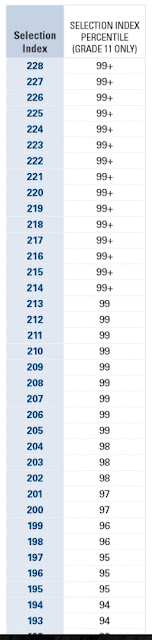 Today the College Board released a National Merit Selection Index Percentile chart that was made up of scores taken from a representative sample of PSAT participants. Obviously the chart would be a lot better if it were made up from all of the actual scores from the October test, and I’m not sure why it wasn’t, but the odds are the sample will be pretty close.
With this chart we can now start to answer the question parents and students have been wondering: “Did my score qualify for National Merit honors?”
And the answer is printed on the chart at right. There were approximately 1.5 million participants, and 50,000 – or three percent – will be honored with at least commended status. If the College Board chart is right, then students who scored a 200 or above will earn Commended status.
Figuring the state cutoffs is more difficult, but it’s not impossible to make a good guess. Each state has a separate cutoff score designed to recognize the top one percent of scorers in that state. The result is that in some states students scoring in the 96th national percentile might get Semifinalist status while kids going to boarding school or in Massachusetts or California would require a score around the 99.7th percentile. All we have to do is look at what percentile a state’s past cutoff scores have been and then see what percentile corresponds to that percentile on the most recent Selection Index chart.
For example, Mississippi’s cutoff score has been rising pretty dramatically over the past 10 years, in part because a number of large school districts have added year-long prep classes to the curriculum. In 2008 Mississippi’s cutoff score was 201 and the national Commended cutoff was 200. So a score that was just barely above the 97th percentile was enough for Semifinalist status.
Last year, Mississippi’s cutoff score was 209 – the highest ever – which tied our state with Alabama, and put us ahead of or equal to 16 states, which was quite an accomplishment for a state used to being on the bottom. That score of 209 put Mississippi square in the middle of the 98th percentile scores, and probably represented a 98.4th percentile if I were to guess.
And by the way, while this post addresses Mississippi PSAT scores, any state which has had cutoff scores below the 99th national percentile ought to be able to get a good idea of where the Class of 2017 cutoff will be. Look at past trends, look at the percentiles, and just hone in on a number.
So now it’s time to look at the chart at right. A cutoff score of 205 is the lowest score in the 99th percentile, and I find it highly likely that Mississippi’s cutoff will be 205 or lower. The same goes for Alabama. Below that things get a bit trickier. The test was poorly designed, so the percentiles drop quickly, with only three scores in the 98th percentile instead of the usual five to seven. I think a score of 203 would correspond with last year’s cutoff.
So the bottom line is that students with a 202 on the PSAT have some chance at Semifinalist status. A 203 is equal to last year, so who knows? A 204 is better. A 205 is in the 99th percentile, and really ought to be enough. And Mississippi (or Alabama) kids with a 207 or higher ought to be making their college visits with the assumption that they will be named Semifinalists.
One requirement to advance from Semifinalist to Finalist status is to make a confirming score on the SAT. Any student with even the slightest chance of earning Semifinalist status should go ahead and take the SAT as soon as possible. On the old SAT a score of 1960 was required to be considered for Finalist, which was roughly the 91st percentile. In other words, they are just making sure people didn't cheat on the lower-security PSAT. Take the SAT early so that if you have a bad test day you can take it again.
My prediction is that the Mississippi cutoff score for the class of 2017 will be 204. The good news for Oxford High School is that after a couple of kind of slim years they may produce a record number of Semifinalists; there are a lot of kids with really good scores. One of those is highly likely to be my son, and I offer him both prayers and congratulations.
Official announcements aren’t made until September. Will any of these children have fingernails left?
Another problem is that the College Board does provide some score percentiles based on what they believe to be a typical sample of test takers. However, it has become more common for students to "prep" for the test, and I suspect their sample doesn't include any hyper-prepared test-takers. The PSAT at present is a very poorly designed test. Hopefully they will work out the problems in the future.
In past years I’ve written quite a bit about the PSAT/National Merit Test. This is the test juniors can take each October as practice for the SAT. In addition, for a lucky few it’s a chance to earn National Merit Semifinalist status, which usually goes on to become Finalist status.
Earning National Merit Finalist status can be financially rewarding. Depending on where one chooses to go to school, it can be worth anywhere from $0 to $2,000 to $200,000. It can be a life-changing event, as I’ve described in many previous posts.
There were some huge changes in the test this year, and the College Board has not handled the transition very well. Students were a month late in getting their scores, and some students still don’t have them. And since the test and scoring scale is entirely changed, nobody is really sure what a “good” score is. The College Board is going back to the old scoring method for the SAT, but just to confuse things they’ve topped out the PSAT with a 760 on each section instead of an 800. And the National Merit Selection score will go back to being calculated with math making up only one-third of the Selection Index but one half of the PSAT score. Understood?

With this chart we can now start to answer the question parents and students have been wondering: “Did my score qualify for National Merit honors?”
And the answer is printed on the chart at right. There were approximately 1.5 million participants, and 50,000 – or three percent – will be honored with at least commended status. If the College Board chart is right, then students who scored a 200 or above will earn Commended status.
Figuring the state cutoffs is more difficult, but it’s not impossible to make a good guess. Each state has a separate cutoff score designed to recognize the top one percent of scorers in that state. The result is that in some states students scoring in the 96th national percentile might get Semifinalist status while kids going to boarding school or in Massachusetts or California would require a score around the 99.7th percentile. All we have to do is look at what percentile a state’s past cutoff scores have been and then see what percentile corresponds to that percentile on the most recent Selection Index chart.
For example, Mississippi’s cutoff score has been rising pretty dramatically over the past 10 years, in part because a number of large school districts have added year-long prep classes to the curriculum. In 2008 Mississippi’s cutoff score was 201 and the national Commended cutoff was 200. So a score that was just barely above the 97th percentile was enough for Semifinalist status.
Last year, Mississippi’s cutoff score was 209 – the highest ever – which tied our state with Alabama, and put us ahead of or equal to 16 states, which was quite an accomplishment for a state used to being on the bottom. That score of 209 put Mississippi square in the middle of the 98th percentile scores, and probably represented a 98.4th percentile if I were to guess.
And by the way, while this post addresses Mississippi PSAT scores, any state which has had cutoff scores below the 99th national percentile ought to be able to get a good idea of where the Class of 2017 cutoff will be. Look at past trends, look at the percentiles, and just hone in on a number.
So now it’s time to look at the chart at right. A cutoff score of 205 is the lowest score in the 99th percentile, and I find it highly likely that Mississippi’s cutoff will be 205 or lower. The same goes for Alabama. Below that things get a bit trickier. The test was poorly designed, so the percentiles drop quickly, with only three scores in the 98th percentile instead of the usual five to seven. I think a score of 203 would correspond with last year’s cutoff.
So the bottom line is that students with a 202 on the PSAT have some chance at Semifinalist status. A 203 is equal to last year, so who knows? A 204 is better. A 205 is in the 99th percentile, and really ought to be enough. And Mississippi (or Alabama) kids with a 207 or higher ought to be making their college visits with the assumption that they will be named Semifinalists.
One requirement to advance from Semifinalist to Finalist status is to make a confirming score on the SAT. Any student with even the slightest chance of earning Semifinalist status should go ahead and take the SAT as soon as possible. On the old SAT a score of 1960 was required to be considered for Finalist, which was roughly the 91st percentile. In other words, they are just making sure people didn't cheat on the lower-security PSAT. Take the SAT early so that if you have a bad test day you can take it again.
My prediction is that the Mississippi cutoff score for the class of 2017 will be 204. The good news for Oxford High School is that after a couple of kind of slim years they may produce a record number of Semifinalists; there are a lot of kids with really good scores. One of those is highly likely to be my son, and I offer him both prayers and congratulations.
Official announcements aren’t made until September. Will any of these children have fingernails left?
Wednesday, September 10, 2014
Madison Central has 21 of 135 National Merit winners; four Semifinalists home-schooled
 |
| Click to enlarge |
I'm going to be blogging quite a bit over the next couple of weeks about the PSAT and National Merit Exam. My reason for giving it so much attention is simple: the PSAT is the most important examination that any really bright student will ever take.
Sure, the ACT, SAT, LSAT, GMAT, GRE, and so forth are important. But they can be taken more than once. Taking the PSAT is like hunting with a single-shot shotgun; one shot is all you get, so you have to be ready. The rewards are immense, with numerous universities with great honors colleges offering automatic free rides to National Merit Finalists.
Oxford High School had fewer Semifinalists than in past years, but four out of 200 is still a better showing than the overwhelming majority of schools.
Items of interest in this year's scores:
● Mississippi has 135 National Merit Semifinalists this year, representing approximately the top one percent of Mississippi high school graduates. The cutoff score for Mississippi this year was 207, the same as last year. The national cutoff score for Commended status was 201, a two-point drop from last year.
● Tupelo got a National Merit Semifinalist! Tupelo High School used to be a real National Merit powerhouse, with as many as 11 Semifinalists in one year. They allowed things to slide, and for the past two years have had none. In an effort to break the slump Tupelo last year offered a nine-week PSAT-prep class limited to those students with a chance of making it. One did. Congratulations Tupelo!
● Four Mississippi Semifinalists are home-schooled, which I found surprising. Perhaps I could teach my children if they would listen to me or obey me, but they won't. Nor do I have the time! I want to know how these parents got they children to obey!
● DeSoto County has 15 Semifinalists this year, which I believe to be a record. DeSoto County is known for good schools and test scores but it hasn't been known for producing lots of National Merit Scholars; perhaps that is going to change. Also interesting is where the finalists came from. Five came from DeSoto Central, probably the best and most affluent school in DeSoto County. Five came from Southaven High; three from Olive Branch High School, one from Lewisburg High School, and one home schooler.
There has been a trickle white- and affluent-flight going on in DeSoto County for several years now, as residents seem to be favoring DeSoto Central and more-recently Lewisburg. I have some friends who bought a weekday-house in the DeSoto Central school district some time back so their child could attend. But very bright students apparently are still getting a fine education at both Southaven High and Olive Branch High.
● Jackson Prep had nine NMSFs, the best of any private school save for St. Andrew's School, which had 12. St. Andrew's has a reputation for being incredibly liberal, as in li-ber-ul; just something to keep in mind if you don't want your kids getting a lot of strange ideas. (Don't get me wrong, I have friends who went to St. Andrew's. Liberal friends, who when telling people where they attended high school refer to it as "that liberal school" in a country-boy accent.)
● Northwest Rankin High School had eight Semifinalists. These folks were not on my radar; congrats!
● The Mississippi School for Math and Science has 10 Semifinalists. MSMS doesn't deserve the credit for this as these students were newly arrived when the took the PSAT, but it does show that there is a quality student body at the school.
● Madison Central High School apparently wears the National Merit crown, with 21 Semifinalists. This is out of about 550 students, and so represents four percent of the student body. Last year Oxford was the top open-enrollment public school in terms of percentages, with about 5.5 percent Semifinalists. Hopefully it will be again next year.
National Merit winners announced with five from Lafayette County; OHS 4, LHS1
 |
| Click to enlarge |
Oxford High School has four National Merit Semifinalists. This is fewer than the 11 last year or the 12 the year before, but is still an outstanding performance. Lafayette County High School has one Semifinalist.
Oxford High School's Semifinalists are William E. Anderson, David M. Dennis, Joonhee Jo, and William G. Tollison. Lafayette County's Semifinalist is Addison E. Roush. Congratulations to these winners, who are now automatically eligible for full-ride scholarships to many universities worth as much a quarter-million dollars!
I'm surprised. I predicted that this year's cutoff would be 205, two points lower than last year. I based this on a two-point drop in the score for commended students, and on the substantial drop in Mississippi critical reading scores. Of course, math and writing scores were up.
The Commended Student cutoff for this year is 201, and this info has been out for quite a while. In 2010 and 2011, and the Semifinalist cutoffs were 203 and 205 respectively, so this year has the largest gap between the Commended cutoff and the NMSF cutoff in Mississippi's testing history.
Most states had a drop in their cutoff score. Alabama, for example, had a four-point drop to tie Mississippi at 207. Alabama's cutoff has tended to be five or six points higher than Mississippi's.

So a 207 Mississippi cutoff means that our state's best students are closing the gap with students from high-achievement states. A large gap still remains, though, as the chart reveals; the Massachusetts cutoff this year is 223.
______________
Source for state cutoff scores: www.collegeconfidential.com
Monday, September 8, 2014
Oxford High does it again with 27 graduates scoring 30 or higher on ACT; six score 35, two 36
I wrote back in April that eight Oxford High School students had scored a 35 or 36 on the ACT and thus qualified to be STAR students.
What I didn't report on was the number scoring 30 or higher. I asked for the information but never got it. The school board recently issued a report showing that 27 OHS students scored 30 or above out of a graduating class of 203.
That comes out to more than 13 percent scoring a 30 or higher. On a statewide level, 931 students out of 28,481 students taking the ACT scored 30 or higher, or 3.25 percent of test-takers. As best I understand it, in Oxford almost every student took the ACT -- 198 out of 203, or 97.5 percent -- while on a statewide level participation rates were lower. So this makes the Oxford scores all the more impressive. (See state report, HERE. See national report, HERE).
Here's the breakdown of the top ACT score distribution:
Also interesting is that Oxford's numbers for 2014 are almost identical to the numbers for 2013. In 2013 Oxford had 12 National Merit Finalists, eight students with 35 or 36 on the ACT, and 27 students with a 30 or higher on the ACT. The 2014 numbers were identical, except that there was one fewer National Merit Finalist.
I've mentioned in the past that there is a lot of brain clustering going on around the nation as families with bright children seek out adequate school systems with other bright kids. A friend of mine calls it "bright-flight." And Oxford is adding a dozen or so of these super-bright kids every year.
Other "bright-flight" clusters include the Madison County School system and St. Andrews School in Jackson. In 2013 11 of Oxford's approximately 225 juniors earned National Merit Semifinalist honors. At Madison Central High School it was about 23 out of 550. Mississippi's top brain-magnet is St. Andrews School in Jackson, where 15 out of about 85 students earned Semifinalist status last year. Of course St. Andrews is both private and selective, so it's not really fair to count them. The same goes for the Mississippi School for Math and Science, where 12 of 120 earned NMSF honors last year. But these kids don't arrive at MSMS until shortly before they take the PSAT.
High ACT scores like Oxford has had the past two years may not happen annually, but more are in store for the future. My son is in 10th grade this year, and five or six students from his grade earned a 30 or higher on the ACT prior to the start of the school year. Given that many, if not most, Mississippi schools don't have a single student to break the ACT 30 barrier, I'd say that having half a dozen do so prior to their entering 10th grade is pretty impressive.
What I didn't report on was the number scoring 30 or higher. I asked for the information but never got it. The school board recently issued a report showing that 27 OHS students scored 30 or above out of a graduating class of 203.
That comes out to more than 13 percent scoring a 30 or higher. On a statewide level, 931 students out of 28,481 students taking the ACT scored 30 or higher, or 3.25 percent of test-takers. As best I understand it, in Oxford almost every student took the ACT -- 198 out of 203, or 97.5 percent -- while on a statewide level participation rates were lower. So this makes the Oxford scores all the more impressive. (See state report, HERE. See national report, HERE).
Here's the breakdown of the top ACT score distribution:
2 - 36 composite scoreAs you can see from the chart above, OHS doesn't have a normal "bell distribution curve." There ought to be a 50- to 60-percent increase in the number of students at each score point below 35, but there isn't. Of course, based on normal score distributions there ought to be a thousand students scoring below 30, but there are only 171. I'd love to have the chance to see the entire OHS score distribution, as I think it would be highly unusual. I suspect Oxford doesn't so much have a bell curve as it does a squiggly line curve.
6 - 35 composite score
1 - 34 composite score
4 - 33 composite score
5 - 32 composite score
5 - 31 composite score
4 - 30 composite score
Also interesting is that Oxford's numbers for 2014 are almost identical to the numbers for 2013. In 2013 Oxford had 12 National Merit Finalists, eight students with 35 or 36 on the ACT, and 27 students with a 30 or higher on the ACT. The 2014 numbers were identical, except that there was one fewer National Merit Finalist.
I've mentioned in the past that there is a lot of brain clustering going on around the nation as families with bright children seek out adequate school systems with other bright kids. A friend of mine calls it "bright-flight." And Oxford is adding a dozen or so of these super-bright kids every year.
Other "bright-flight" clusters include the Madison County School system and St. Andrews School in Jackson. In 2013 11 of Oxford's approximately 225 juniors earned National Merit Semifinalist honors. At Madison Central High School it was about 23 out of 550. Mississippi's top brain-magnet is St. Andrews School in Jackson, where 15 out of about 85 students earned Semifinalist status last year. Of course St. Andrews is both private and selective, so it's not really fair to count them. The same goes for the Mississippi School for Math and Science, where 12 of 120 earned NMSF honors last year. But these kids don't arrive at MSMS until shortly before they take the PSAT.
High ACT scores like Oxford has had the past two years may not happen annually, but more are in store for the future. My son is in 10th grade this year, and five or six students from his grade earned a 30 or higher on the ACT prior to the start of the school year. Given that many, if not most, Mississippi schools don't have a single student to break the ACT 30 barrier, I'd say that having half a dozen do so prior to their entering 10th grade is pretty impressive.
Wednesday, August 27, 2014
In 20-20 hindsight, Jackson Prep player's death was both predictable and preventable
 |
| Walker Wilbanks |
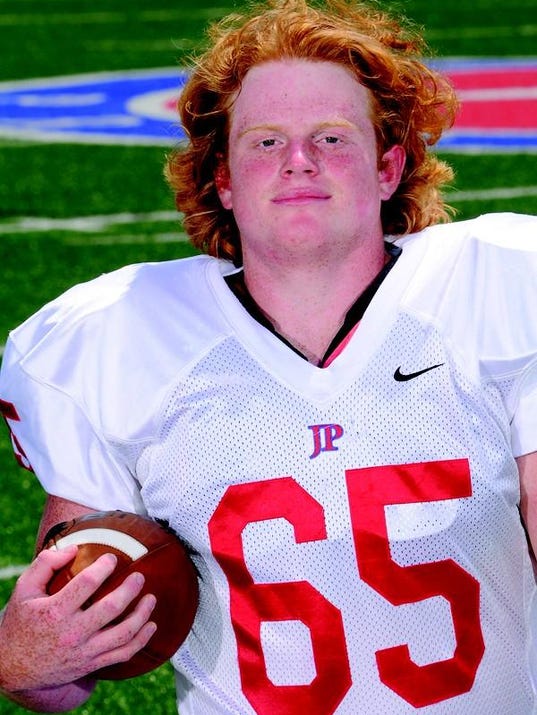
"Please don't overreact. Don't let this alter the way you prepare for games," he said. "Friday night was an isolated incident. He couldn't have prepared for it. No one could," Pressler said. "There are times where there are no answers medically, and that's what we're dealing with here."
I'm not a doctor but I disagree with this one. There are certainly some unanswered questions, such as whether or not Wilbanks might have been taking a diuretic, for example (which can cause hyponatremia), but I'm not willing to accept that such deaths can't be prevented.
First, I only played football for a single year. I was terrible. But I remember on really hot days the coaches would give us salt pills. My understanding is that salt pills are no longer given. Why? I've never heard of anyone dying from taking a proper dosage of salt pills before a football game, but I now know of one who died because of a lack of salt in his system.
Second, when football players practice and play in extreme heat bad things, including the possibility of death, are more likely to happen. The high temperature at the Jackson airport on August 23 was 93 degrees. At 6:53 the temperature was 90 with a heat index of 95.4. These temperatures were recorded on the outskirts of the city, and are likely lower than those that existed on the Jackson Prep field. I think it is obvious that had temperatures been cooler Wilbanks would be alive today.
Following the death of a football player to heat stroke the state of Kentucky adopted rigid rules concerning practices in heat. With a heat index of 95 or above the following steps are required:
Provide ample amounts of water. This means that water should always be available and athletes should be able to take in as much water as they desire.Unlike a practice, a football game doesn't allow 10-minute water breaks every half rour. Players can't always remove their helmets. And the outside activity can't be reduced or postponed.
Mandatory water breaks every 30 minutes for 10 minutes in duration
Ice-down towels for cooling
Watch/monitor athletes carefully for necessary action.
Contact sports and activities with additional equipment
Helmets and other possible equipment removed if not involved in contact.
Reduce time of outside activity. Consider postponing practice to later in the day.
Re-check temperature and humidity every 30 minutes to monitor for increased Heat Index.
But there is a solution: Don't allow football games in August!
School traditionally began the Tuesday after Labor Day, with the first football game perhaps the Friday after Labor Day. Labor Day marks the end of summer for a reason; temperatures drop with every passing day.
I don't blame anyone for Wilbanks' death. But in hindsight it wasn't a "freak," unpreventable occurrence. It was predictable and preventable. We need to attempt to discover as many facts as possible and work together to prevent such deaths in the future.
We can prevent future deaths by banning August football games and by making sure players have a high enough sodium level, whether it's achieved with salt pills, energy drinks, or something else. As a state we need to regulate football practice conditions as well. These changes can come from the athletic associations or from the legislature; I don't care which.
As a state we have a choice. We can make some changes, or we can decide to bury some more teen-agers. Because when another kid dies, it won't be a "fluke." It will be because we allowed it to happen.
Wednesday, June 18, 2014
Feds force Oxford Schools to make students pay more for lunches that they like less
The Oxford School District is raising the price of full-pay lunches from $2.25 to $2.75 for the next school year, according to a memo from Nutrition Director Richmond Smith to the school board.
The memo states that the increase is being mandated by Section 205 of the Hunger-Free Kids Act of 2010. Essentially what the federal government has done is to force school districts to comply with all sorts of expensive federal directives in exchange for increased reimbursements for students on the free and reduced lunch program.
Now the schools are being required by the federal government to raise prices on full-pay students to help pay for lunch changes that they did not want and do not like.
Oxford is not alone in raising prices. Schools all over the country are increasing prices to comply with this new federal intrusion. And some schools are just opting out of the federal school lunch program altogether. Almost 1,500 school have said "No thank you" to federal funding and regulation of school lunches since changes went into effect.
Nationally about 1.6 million full-pay students have stopped buying their lunch at school since the federal government began micromanaging the program. That's about seven percent of the 25 million students who were buying their own lunch at school each day. With lunch prices increasing, expect this number to rise. Most people don't like to pay more and get less.
I don't blame the Oxford School District for making these changes; it is just complying with federal law. But this is certainly an example of how an increase in federal spending can make the lives of the supposed beneficiaries worse instead of better.
The memo states that the increase is being mandated by Section 205 of the Hunger-Free Kids Act of 2010. Essentially what the federal government has done is to force school districts to comply with all sorts of expensive federal directives in exchange for increased reimbursements for students on the free and reduced lunch program.
Now the schools are being required by the federal government to raise prices on full-pay students to help pay for lunch changes that they did not want and do not like.
Oxford is not alone in raising prices. Schools all over the country are increasing prices to comply with this new federal intrusion. And some schools are just opting out of the federal school lunch program altogether. Almost 1,500 school have said "No thank you" to federal funding and regulation of school lunches since changes went into effect.
Nationally about 1.6 million full-pay students have stopped buying their lunch at school since the federal government began micromanaging the program. That's about seven percent of the 25 million students who were buying their own lunch at school each day. With lunch prices increasing, expect this number to rise. Most people don't like to pay more and get less.
I don't blame the Oxford School District for making these changes; it is just complying with federal law. But this is certainly an example of how an increase in federal spending can make the lives of the supposed beneficiaries worse instead of better.
Thursday, May 15, 2014
Oxford School District orchestra holds end-of-year concert May 14
The Oxford School District held its end-of-year orchestra concert May 14 at Nutt Auditorium on the Ole Miss campus. I thought they gave a fine performance.
For the past several years I tried to record some of my daughter's orchestra concerts. Obviously there are a lot more children involved than just my daughter.
I didn't take my video camera to the Christmas 2013 concert, which featured some choral music as well as orchestra tunes. I was simply blown away by five kids performing "Mary Did You Know" in a street-singing style. I called my friend Ed Meek and asked him to have someone from HottyToddy.com film these kids, and he did; and so I was able to include it on my blog.
In past years I've recorded snippets of songs. Last year I made a separate video for each song. One of the things that I find interesting is the obvious improvement that takes place as these children get older.
This year I decided to just record the entire performance of each group in full, without any editing. I did miss the first song performed by the high school, Furiant, by Elliot Del Borgo, as they started player before I got the "record" button pressed. I zoomed in once on each group to try to get video of each performer; however, many were in the back and out of the view of my camera. Oh well!
Most people won't want to watch all of these videos in their entirety. But here it is for those who might have friends or family members in the orchestra. For the general public, I strongly urge you to listen to a few snippets, anyway. Oxford is lucky to have a quality orchestra program in its schools.
The Oxford School District Orchestra is under the instruction of Tyler Kuntz. Kuntz said the high school orchestra had to cancel its plans earlier this year to participate in a rating competition earlier this year due to inclement weather, but that the middle school participated and received outstanding marks, with almost no negative comments.
Kuntz said he would announce in the fall the fact that he had registered the orchestra to participate in a four-day competition in St. Louis next year. The trip will include a visit to Six Flags, of course. Readers of this blog won't have to wait for the announcement.
And now for the videos:
For the past several years I tried to record some of my daughter's orchestra concerts. Obviously there are a lot more children involved than just my daughter.
I didn't take my video camera to the Christmas 2013 concert, which featured some choral music as well as orchestra tunes. I was simply blown away by five kids performing "Mary Did You Know" in a street-singing style. I called my friend Ed Meek and asked him to have someone from HottyToddy.com film these kids, and he did; and so I was able to include it on my blog.
In past years I've recorded snippets of songs. Last year I made a separate video for each song. One of the things that I find interesting is the obvious improvement that takes place as these children get older.
This year I decided to just record the entire performance of each group in full, without any editing. I did miss the first song performed by the high school, Furiant, by Elliot Del Borgo, as they started player before I got the "record" button pressed. I zoomed in once on each group to try to get video of each performer; however, many were in the back and out of the view of my camera. Oh well!
Most people won't want to watch all of these videos in their entirety. But here it is for those who might have friends or family members in the orchestra. For the general public, I strongly urge you to listen to a few snippets, anyway. Oxford is lucky to have a quality orchestra program in its schools.
The Oxford School District Orchestra is under the instruction of Tyler Kuntz. Kuntz said the high school orchestra had to cancel its plans earlier this year to participate in a rating competition earlier this year due to inclement weather, but that the middle school participated and received outstanding marks, with almost no negative comments.
Kuntz said he would announce in the fall the fact that he had registered the orchestra to participate in a four-day competition in St. Louis next year. The trip will include a visit to Six Flags, of course. Readers of this blog won't have to wait for the announcement.
And now for the videos:
Friday, May 9, 2014
Oxford High School and Middle School to start later next year; science says the later the better
The Oxford School District is going to separate bus routes next year so that high school and middle school students will be served by different bus routes from elementary students, the Oxford Eagle reports from behind a pay wall. The change will also push back the start time at the high school and middle school by about 30 minutes.
District Superintendent Brian Harvey said there haven't been any problems to date, but that having separate buses would create a more comfortable environment for younger children. The change is also designed to address serious traffic problems that have existed since the opening of the new high school, which have made it difficult for the buses to go to all schools in a timely manner.
“This is something that we have thought about for a number of years because we want our parents to feel safe that their kids can ride the buses,” OSD Superintendent Brian Harvey told the Eagle. “We haven’t had any issues that other school districts haven’t encountered, but the school bus climate is something we feel we can improve on.”
This is great news for Oxford's students, even though it appears that the primary reason for the change is due to logistics and not as an aid to student performance. Numerous studies have shown that teens are biologically programmed to go to sleep later in the evening and that early school days deprive them of the sleep they need. U.S. Secretary of Education Arne Duncan supports later start times, and sent out a "Tweet" last year which said, "Common sense to improve student achievement that too few have implemented: let teens sleep more, start school later."
And to Harvey's credit he did mention studies showing an increase in student performance with a later start time. “We’ve also looked at research that said that secondary students improve with student achievement and even ACT scores (by a later school start time),” Harvey told the Eagle.
If you don't want to bother reading a study, just read this recent New York Times article, which reports on the benefits later school start times. Or check out the website of Start School Later, an organization that promotes reasonable and healthy school start times.
When we first moved to Oxford we rented a condo that was the very first stop on the bus route. My recollection is that if the children wanted to ride the bus they needed to be at the bus stop at something like 6:25 a.m. The bus stop was at least a five minute walk away, so that meant they would have needed to be out the door by 6:20, and in order to do that the entire family would have had to get up at 5:30 a.m. Needless to say, the kids did not ride the bus.
But enough of personal anecdote; let's go back to the study I cited above. The last sentence of the last page says it all: [T]he findings of this research study reveal that there are empirically-based positive outcomes for adolescents whenever the start time of their high school is moved to a later time — with the starting time of 8:30 AM or later clearly showing the most positive results.
Students in the above survey were asked what time they thought school should start. Fewer than 10 percent wanted a start time before 8 a.m., which Oxford now has. Almost 51 percent wanted a start time of 9 a.m. or later, and 75 percent wanted a start time of 8:30 a.m. or later.
Our schools exist to serve the students, and if they want and need a later start time that's what they ought to get. This is especially true when substantial empirical evidence shows that a later start will improve their academic, emotional, and physical health.
The tardy bell at Oxford High School currently rings at 7:50 a.m. Superintendent Harvey mentioned a 8:20 or 8:30 a.m. start time for the middle and high schools next year. Eight-thirty would certainly be an improvement, and based on prior studies Oxford will see an improvement in student performance with these changes. I use the word "will" because I'm pretty confident that the later start time will produce measurable improvement.
But if the school district really wants to improve academic performance and increase student health and well-being, the first tardy bell for the 2014-15 school year will ring at 9 a.m.
District Superintendent Brian Harvey said there haven't been any problems to date, but that having separate buses would create a more comfortable environment for younger children. The change is also designed to address serious traffic problems that have existed since the opening of the new high school, which have made it difficult for the buses to go to all schools in a timely manner.
“This is something that we have thought about for a number of years because we want our parents to feel safe that their kids can ride the buses,” OSD Superintendent Brian Harvey told the Eagle. “We haven’t had any issues that other school districts haven’t encountered, but the school bus climate is something we feel we can improve on.”
This is great news for Oxford's students, even though it appears that the primary reason for the change is due to logistics and not as an aid to student performance. Numerous studies have shown that teens are biologically programmed to go to sleep later in the evening and that early school days deprive them of the sleep they need. U.S. Secretary of Education Arne Duncan supports later start times, and sent out a "Tweet" last year which said, "Common sense to improve student achievement that too few have implemented: let teens sleep more, start school later."
And to Harvey's credit he did mention studies showing an increase in student performance with a later start time. “We’ve also looked at research that said that secondary students improve with student achievement and even ACT scores (by a later school start time),” Harvey told the Eagle.
If you don't want to bother reading a study, just read this recent New York Times article, which reports on the benefits later school start times. Or check out the website of Start School Later, an organization that promotes reasonable and healthy school start times.
When we first moved to Oxford we rented a condo that was the very first stop on the bus route. My recollection is that if the children wanted to ride the bus they needed to be at the bus stop at something like 6:25 a.m. The bus stop was at least a five minute walk away, so that meant they would have needed to be out the door by 6:20, and in order to do that the entire family would have had to get up at 5:30 a.m. Needless to say, the kids did not ride the bus.
But enough of personal anecdote; let's go back to the study I cited above. The last sentence of the last page says it all: [T]he findings of this research study reveal that there are empirically-based positive outcomes for adolescents whenever the start time of their high school is moved to a later time — with the starting time of 8:30 AM or later clearly showing the most positive results.
Students in the above survey were asked what time they thought school should start. Fewer than 10 percent wanted a start time before 8 a.m., which Oxford now has. Almost 51 percent wanted a start time of 9 a.m. or later, and 75 percent wanted a start time of 8:30 a.m. or later.
Our schools exist to serve the students, and if they want and need a later start time that's what they ought to get. This is especially true when substantial empirical evidence shows that a later start will improve their academic, emotional, and physical health.
The tardy bell at Oxford High School currently rings at 7:50 a.m. Superintendent Harvey mentioned a 8:20 or 8:30 a.m. start time for the middle and high schools next year. Eight-thirty would certainly be an improvement, and based on prior studies Oxford will see an improvement in student performance with these changes. I use the word "will" because I'm pretty confident that the later start time will produce measurable improvement.
But if the school district really wants to improve academic performance and increase student health and well-being, the first tardy bell for the 2014-15 school year will ring at 9 a.m.
Thursday, May 8, 2014
Oxford High School senior Zhao named one of 141 U.S. Presidential Scholars

The 2014 U.S. Presidential Scholars are comprised of one young man and one young woman from each state, the District of Columbia and Puerto Rico, and from U.S. families living abroad, as well as 15 chosen at-large and 20 U.S. Presidential Scholars in the Arts.
The White House Commission on Presidential Scholars, appointed by President Obama, selects honored scholars annually based on their academic success, artistic excellence, essays, school evaluations and transcripts, as well as evidence of community service, leadership, and demonstrated commitment to high ideals. Of the three million students expected to graduate from high school this year, more than 3,900 candidates qualified for the 2014 awards determined by outstanding performance on the College Board SAT and ACT exams, and through nominations made by Chief State School Officers or the National YoungArts Foundation’s nationwide YoungArts™ competition.
Zhao was one of Oxford's eight STAR Students this year, as a result of an ACT score of 35 or 36, and is one of Oxford's 11 National Merit Finalists in the Class of 2014. He is an AP Scholar with Distinction, an honor given to students with a 3.5 or higher grade-point-average who score 3 or higher on at least five AP exams.
Zhao is the son of Mei Wang and Jianping Zhao. He is Captain of the Envirothon Team, Co-Captain of the Science Olympiad Team, Captain of the Math and Science Quiz Bowl Team, and a member of the Robotics Team. He plans to major in Electrical Engineering in college.
Tuesday, April 22, 2014
In 2013 OHS had almost 30 percent of Mississippi's 35-36 ACT scores, with eight out of 27
I've made no secret that I'm impressed with the fact that Oxford High School has eight students with a 35 or 36 on the ACT this year, and that it had the same number last year.
This is from a statistical standpoint, simply phenomenal.
According to the official ACT report, in 2013 twenty-seven Mississippi seniors scored 35 or 36 on the ACT. Eight of that 27 were from Oxford High School. A total of 27,749 seniors took the ACT in 2013; 217 Oxford seniors took it. So Oxford seniors accounted for about eight-tenths of one percent of ACT test-takers and produced almost 30 percent of those making a 35 or 36.
This is from a statistical standpoint, simply phenomenal.
According to the official ACT report, in 2013 twenty-seven Mississippi seniors scored 35 or 36 on the ACT. Eight of that 27 were from Oxford High School. A total of 27,749 seniors took the ACT in 2013; 217 Oxford seniors took it. So Oxford seniors accounted for about eight-tenths of one percent of ACT test-takers and produced almost 30 percent of those making a 35 or 36.
Monday, April 21, 2014
Oxford High ties last year's record number of STAR Students, with eight who scored 35 or 36 on ACT
 |
| Oxford High School STAR Students are Brian Clancy, Matthew Forgette, Connor Goggins, Shreya Mathur, Joshua Redding, Cynthia Torma, Joelle Young, and Mark Zhao. |
I wrote last year about how Oxford High set a state record with eight STAR Students. Now they've done it again! Oxford has eight STAR Students again for 2014. This is just unheard of.
STAR Students are named each year by the Mississippi Economic Council. Recipients must be graduating seniors with a 93 average in core subjects, the highest ACT score in their class, and an ACT of at least 25. Students with a 35 or 36 on the ACT get STAR Student status whether their score is highest in the class or not.
So in 2013 Oxford High School had eight out of roughly 225 students with a score of 35 or 36 on the ACT; and they've given us a repeat performance for 2014. Roughly 3.5 percent of the Oxford High School graduating class last year and this year had an ACT score of 35 or 36.
In 2012 there were 5,238 students nationally with a 35 or 36 on the ACT out of 1,666,017 taking the test. So about three-tenths of one percent nationally made a 35 or 36 while 3.5 percent of Oxford seniors posted a 35 or 36.
It's an amazing performance, and we shouldn't get too spoiled. It's unlikely to have these kinds of numbers every year, but I can sure enjoy them while they last!
Here's the story from the Oxford High School website:
Eight Oxford High School students have been named as STAR (Student-Teacher Achievement Recognition) Students for the 2013-2014 school year by the Mississippi Economic Council’s (MEC) M.B. Swayze Foundation, sponsor of the STAR program. Oxford High School STAR Students are Brian Clancy, Matthew Forgette, Connor Goggins, Shreya Mathur, Joshua Redding, Cynthia Torma, Joelle Young, and Mark Zhao. The Oxford High School students were honored during the annual Education Celebration at the MEC Annual Meeting on April 10 at the Jackson Convention Complex in downtown Jackson.
According to Oxford school officials, this year Oxford High School had the highest number of STAR Students representing any school district in the state of Mississippi.
As part of the STAR Program each STAR Student is asked to designate a STAR Teacher, the teacher who has made the greatest contribution to the student’s scholastic achievement. STAR Teachers are Chris Baughman, Dr. Barbara Lowe, James Reidy, Allyson Movitz, Stefanie Beam, Anne Steel, Renee Dayan, and Marni Herrington. The STAR Teacher can be one of the STAR Student’s elementary or secondary classroom teachers (active, former or retired).
STAR Students are selected on the basis of academic excellence. Both American College Test (ACT) scores and scholastic averages are compared to determine the school's STAR Student. MEC and its M.B. Swayze Foundation sponsor the STAR Program to encourage and promote academic achievement among Mississippi’s high school seniors as well as recognize the teacher profession.
A Closer look at the STAR Students
Brian Clancy
Brian Clancy is the son of Sally and Thomas Clancy. Brian is a member of the Swim Team, the Math and Science Team, FIRST Robotics Team, Envirothon Team, Science Olympiad, and the Asian Heritage Club. He is active in his church youth group and is an AP Scholar. He plans on majoring in Business in college.
STAR Teacher is Chris Baughman.
Matthew Forgette
Matthew Forgette is the son of Karen and Rick Forgette. Matthew is the Debate Team Co-Captain and has twice been named a National Debate Tournament Qualifier. He is a state finalist Mock Trail Team member and a member of the State Champion Oxford Tennis Team. He is in the National Honor Society and is a National Merit Finalist. Matthew plans on majoring in International Studies and Economics.
STAR Teacher is Dr. Barbara Lowe.
Connor Goggins
Connor Goggins is the son of Patricia Krueger and Paul Goggins. He is a member of the FIRST Robotics Team, the Math and Science Team, Debate Team, Science Olympiad Team, and the Science Team. He has been active with the OHS Theatre and is an AP Scholar with Honor. Connor plans on majoring in Computer Engineering.
STAR Teacher is James Reidy.
Shreya Mathur
Shreya Mathur is the daughter of Masisha and Dr. Sunil Mathur. Shreya is a member of the Robotics Team, Science Olympiad Team, Math and Science Team, Key Club, Anchor Club, and the National Honor Society. At the 2012 International Science Fair, Shreya placed 4th in Mathematics and 1st Place in American Statistical Association Awards. Shreya plans on studying Biostatistics in college.
STAR Teacher is Allyson Movitz.
Joshua Redding
Joshua Redding is the son of Melinda and Steve Redding. Joshua is a Robotics Team member, and a member of Fellowship of Christian Athletes and Envirothon Team. Joshua is active with the youth group at his church. He is Science Olympiad Co-Captain and President of the German Club. Joshua plans on majoring in Computer Science in college.
STAR Teacher is Stefanie Beam.
Cynthia Torma
Cynthia Torma is the daughter of Eva Bodnar and Tibor Torma. Cynthia is a Poetry Out Loud State Semifinalist, Captain of the OHS Swim Team, and an Intel International Science and Engineering Fair Finalist. She is a National Merit Finalist and an AP Scholar with Distinction. Cynthia plans on majoring in Linguistics and Biochemistry.
STAR Teacher is Anne Steel.
Joelle Young
Joelle Young is the daughter of Shae Wang. Joelle is Treasurer of the German Club, a member of the Envirothon Team, a National Merit Finalist, and an AP Scholar. She is the Mississippi Music Teachers Association State Piano Competition winner and a state winner in the American Math Competition. Joelle plans on majoring in Molecular Biology and Psychology.
STAR Teacher is Renee Dayan.
Mark Zhao
Mark Zhao is the son of Mei Wang and Jianping Zhao. Mark is Captain of the Envirothon Team, Co-Captain of the Science Olympiad Team, Captain of the Math and Science Quiz Bowl Team, and a member of the Robotics Team. He is a National Merit Finalist and an AP Scholar with Distinction. Mark plans on majoring in Electrical Engineering in college.
STAR Teacher is Marni Herrington.
Wednesday, March 19, 2014
Oxford students all atwitter after discovery of new anonymous social media app
The newest social media app, Yik Yak, has arrived in Oxford, or more precisely at Oxford High School. It was apparently unknown to most students before the school bell rang Tuesday morning, but by 3 p.m. virtually every student with a phone had downloaded it.
The Twitter-like app, designed for college students, allows anonymous posts which are only visible to those in roughly a five-mile radius. Then high school students found out about it. What works okay for college students doesn't work so well for high schoolers trapped in the same building together all day. The app has been a nightmare for school administrators around the nation, who say that it has been used for bullying.
Yik Yak's developers disabled the app at all Chicago schools earlier this month, and went on to apply a GPS block at all U.S. middle and high schools. Of course, Oxford High has only been in its current location a few months and it apparently isn't in the database. So Oxford students spent Tuesday anonymously spouting off about things or students they didn't like.
Yik Yak is essentially a digital version of the "burn book" from the movie "Mean Girls." Hopefully school officials will contact the app's developers and request to be included in the school-exclusion database.
____________
Below is the clip from the movie that shows the aftermath of a burn book gone viral.
The Twitter-like app, designed for college students, allows anonymous posts which are only visible to those in roughly a five-mile radius. Then high school students found out about it. What works okay for college students doesn't work so well for high schoolers trapped in the same building together all day. The app has been a nightmare for school administrators around the nation, who say that it has been used for bullying.
Yik Yak's developers disabled the app at all Chicago schools earlier this month, and went on to apply a GPS block at all U.S. middle and high schools. Of course, Oxford High has only been in its current location a few months and it apparently isn't in the database. So Oxford students spent Tuesday anonymously spouting off about things or students they didn't like.
Yik Yak is essentially a digital version of the "burn book" from the movie "Mean Girls." Hopefully school officials will contact the app's developers and request to be included in the school-exclusion database.
____________
Below is the clip from the movie that shows the aftermath of a burn book gone viral.
Wednesday, January 15, 2014
Oxford creates dedicated lanes in effort to relieve Sisk Ave. traffic woes
 |
| Click to Enlarge |
Police have placed cones on Sisk to create dedicated lanes at the Highway 7 interchange. I saw the placement of the cones when I dropped Ash off for school this morning. Essentially they have created a dedicated lane for north-bound traffic coming off of Highway 7 and another lane for traffic coming east on Sisk. Sisk expands to four lanes east of the Highway 7 interchange, so this should allow a substantial improvement in traffic flow.
I would expect there to be some initial confusion, but when it settles down this should improve traffic flow quite a bit. The dedicated lanes do require a lane-shift for those traveling east on Sisk, and this might be confusing at first. I do hope the city will install the cones and poles permanently instead of merely placing them there each morning and afternoon.
In my opinion, the best route into the school is now to come in from the south on Highway 7. This will involve no stopping, since there is a dedicated lane. The worst way in is probably to come in from the north on Highway 7. It might be a better strategy for those living north of town to exit at Highway 30 and then take Park Drive to Sisk; this will be a matter of trial and error.
The strategy that has worked at our house for the past couple of days is to try to be out of the driveway before 7:05 a.m. This puts us on Sisk within five minutes and at the drop-off point in 10. Believe it or not the traffic is actually heavy on Sisk at 7:10 a.m., presumably with other parents who don't want to get stuck waiting 30 minutes in traffic to drop off their kids. I hope the kids will keep getting out of the bed and into the car early!
A friend of mine pointed out an additional problem with the traffic problems on Sisk: There is a real safety issue with two large schools having only one road leading in or out. A major accident at the Sisk and 7 interchange could prevent emergency vehicles from reaching either Della Davidson or Oxford High. An additional way into the area simply must be built.
In the meantime, here's hoping that a dedicated lane and getting to school a little earlier provides us with some relief!
Monday, January 13, 2014
The new Oxford High School is beautiful but the traffic jam on Sisk is a nightmare
 |
| The New Oxford High School |
Oxford High School students started the new year in a new school. The new buildings were sorely needed and it is a beautiful campus.
With the opening of the new school, located at the end of Sisk Ave., Oxford starts the new year with a really nasty traffic problem. Sisk was barely able to handle the traffic created by parents dropping off or picking up their kids from Della Davidson Elementary. Now traffic on Sisk has tripled.
This heavy traffic means that cars are backed up more than a mile on Sisk Ave before and after school. They're backed up up on Bramlett, too. The Highway 7 exit ramps are completely full, so that cars are backed up into the highway. Not only are parents late getting their kids to school, so are a few of the school buses.
Long-term solutions have to include substantial road improvements. Hopefully this will include the building of two roundabouts where Highway 7 meets Sisk. (And while we're at it, lets throw in two roundabouts at University and 7, and Old Taylor and Highway 6).
For the short term the school may need to make some substantial changes in its hours so that the Della and Oxford High parents don't descend on Sisk at the exact same time.
I imagine we'll start trying to leave our house at 7 a.m. My experience is that being a few minutes early turns a 45-minute school trip into a 15-minute breeze. But having to leave home at 7 a.m. to make a 7:50 a.m. school bell is pretty sad.
Thursday, December 19, 2013
I lost my camcorder, but hottytoddy.com pulled through for me and shot this great video
Back in my Ole Miss student days I was a real thorn in the side of Ed Meek, who was the head of public relations for the university. Neither of us ever had a cross word with each other, but I'm sure I irritated him no end.
Time is a salve that heals all wounds. Since moving back to Oxford three years ago I've found that Ed and I are frequently on the same page, and I am proud to call him a friend.
For the past couple of years I've been recording the Oxford School District orchestra concerts that my daughter has participated in and have posted them on this blog and on Youtube. Unfortunately, I have lost my video camera and wasn't able to film these year's concert. I miss my video camera.
And it's a shame, too. It was a great concert. It was a big change from year's past. Members of the various orchestras remained in their seats on stage for the entire concert, so there was no 15-minutes of switching and tuning between the beginner, 7th & 8th grade, and high school orchestra. And the choir was invited to participate and contributed several great choral performances.
I have a short attention span, and the concert just whizzed by. I would honestly recommend to any Oxford resident that they attend future concerts. It was top notch.
I wish I could say the highlight of the evening was my daughter's cello playing, but it wasn't. It was the performance of a quintet which sang the modern Christmas carol, "Mary Did You Know?" in what I would call a street-singing style. I'm not predisposed to care for this type of music, but I loved it.
I was truly saddened that I wasn't able to record this and share it on my blog. So I sent Ed Meek an email and told him about the group and asked him to see if he could get someone from his news website, hottytoddy.com to do a story and perhaps get a video of this fine group. Ed Meek and hottytoddy.com came through for me. Thank you Ed! Thank you hottytoddy.com!
These students arranged this song by themselves. They give us cause to be proud of our local schools and our city. And we're proud of them, too.
I've already posted the hottytoddy video at the top of this post, but click this link to see the hottytoddy.com story on the quintet.
Time is a salve that heals all wounds. Since moving back to Oxford three years ago I've found that Ed and I are frequently on the same page, and I am proud to call him a friend.
For the past couple of years I've been recording the Oxford School District orchestra concerts that my daughter has participated in and have posted them on this blog and on Youtube. Unfortunately, I have lost my video camera and wasn't able to film these year's concert. I miss my video camera.
And it's a shame, too. It was a great concert. It was a big change from year's past. Members of the various orchestras remained in their seats on stage for the entire concert, so there was no 15-minutes of switching and tuning between the beginner, 7th & 8th grade, and high school orchestra. And the choir was invited to participate and contributed several great choral performances.
I have a short attention span, and the concert just whizzed by. I would honestly recommend to any Oxford resident that they attend future concerts. It was top notch.
I wish I could say the highlight of the evening was my daughter's cello playing, but it wasn't. It was the performance of a quintet which sang the modern Christmas carol, "Mary Did You Know?" in what I would call a street-singing style. I'm not predisposed to care for this type of music, but I loved it.
I was truly saddened that I wasn't able to record this and share it on my blog. So I sent Ed Meek an email and told him about the group and asked him to see if he could get someone from his news website, hottytoddy.com to do a story and perhaps get a video of this fine group. Ed Meek and hottytoddy.com came through for me. Thank you Ed! Thank you hottytoddy.com!
These students arranged this song by themselves. They give us cause to be proud of our local schools and our city. And we're proud of them, too.
I've already posted the hottytoddy video at the top of this post, but click this link to see the hottytoddy.com story on the quintet.
Thursday, September 26, 2013
Twenty-seven of 224 Oxford High seniors last year scored 30 or higher on the ACT
I recently posted congratulations to Oxford High School's 11 National Merit Semifinalists. And I mentioned once again that this massive number of Semifinalists isn't an anomaly, but rather the result of ongoing brain clustering in the Oxford Community.
This brain clustering is one of the most important socio-economic trends occurring in both our state and nation, and I'm going to post some more thoughts at a future time.
Anyway, two days after my National Merit post, in which I stated my opinion that Oxford High School is the best open-enrollment high school in the state, the School District posted on Facebook that 27 of the 217 seniors last year who took the ACT scored a 30 or higher. And there are only 224 seniors, so almost every student took the ACT.
The school district's post:
Of course congratulations to all of these students are in order; but the school district and the community as a whole are to be congratulated as well. And I am desperate to know whether there is an open enrollment public school in the entire nation with a greater percentage of high scorers.
This brain clustering is one of the most important socio-economic trends occurring in both our state and nation, and I'm going to post some more thoughts at a future time.
Anyway, two days after my National Merit post, in which I stated my opinion that Oxford High School is the best open-enrollment high school in the state, the School District posted on Facebook that 27 of the 217 seniors last year who took the ACT scored a 30 or higher. And there are only 224 seniors, so almost every student took the ACT.
The school district's post:
Oxford school officials just announced that 27 Oxford High School seniors in the 2013 graduating class scored a composite score of 30 or above on the ACT college entrance exam, reaffirming what school officials know: Oxford High School seniors continue to perform at the top among their peers on the national college entrance exam.I would guess that perhaps half of Mississippi high schools did not have a single senior who scored a 30 or higher on the ACT last year. In fact, quite a few don't have a STAR student every year, as that award requires a minimum ACT of 25. So for Oxford to produce 27 of these high scorers -- 12 percent of the senior class -- is just unheard of.
Of 224 Oxford High seniors, 217 took the ACT: that’s 97 percent of the 2013 senior class who took the ACT. It's also the highest number of high school seniors who have ever taken the ACT at Oxford High.
Of course congratulations to all of these students are in order; but the school district and the community as a whole are to be congratulated as well. And I am desperate to know whether there is an open enrollment public school in the entire nation with a greater percentage of high scorers.
Monday, September 23, 2013
Congratulations to Oxford High's 11 National Merit Semifinalists -- about five percent of junior class
 |
| National Merit Scholarship Program semifinalists are: Abbigail Pullen, Yuqi Zhao, Dion Kevin, Brian Clancy, Matthew Forgette, Yoomin Jo, Joelle Young, Cynthia Torma, Shreya Mathur, Mary Kathryn Pearson, and Reid Mallette. |
I mentioned about three weeks ago that the release of National Merit semifinalists was coming soon. It came and not a word from me. Better late than never.
Once again Oxford High School had a tremendous number of semifinalists: Eleven this year. Last year the school boasted a record 12 semifinalists. I said at the time I didn't think these large Semifinalist numbers were an anomaly. I believe they are the wave of the future. People from throughout the Delta and other parts of the state are flocking to Oxford because of the good school system. The type of parents who are willing to make this type of move tend to have smart children, sometimes very smart.
The Tupelo Daily Journal reported the names of Northeast Mississippi students who made the Semifinalist cut this year. There were a total of 18 Semifinalists in the entire northeast region covered by that newspaper, which goes as far west as Lafayette and Marshall Counties and as far south as Oktibbeha County. Eleven of the 18 were from Oxford High School. They are:
- Brian Clancy
- Matthew Forgette
- Yoomin Jo
- Dion Kevin
- Reid Mallette
- Shreya Mathur
- Mary Pearson
- Abbigail Pullen
- Cynthia Torma
- Joelle Young
- Yuqi Zhao
There are approximately 16,000 Semifinalists nationally; this year Mississippi had 136. Each state has a separate cutoff score, which is designed to recognize the top one percent of students in each state, and so the number from a low-population state will fluctuate a good bit each year, as it is impossible to set a score that will recognize exactly one percent. Mississippi's cutoff score this year was 207, up three points from last year. By comparison, Tennessee has a cutoff score of 212; Massachusetts and New Jersey have cutoffs of 224. National Merit also offers "Commended" status to the almost-made-its, roughly the top four percent. This year the national cutoff for Commended status was 203 for all states, unchanged from last year.
The Mississippi School for Math and Science apparently led the National Merit race statewide (from a percentage standpoint), with 12 of approximately 120 juniors being selected, or about 10 percent. Of course, MSMS should do well; it's a magnet boarding school that only takes extremely bright kids.Oxford had 11 out of approximately 220 students selected, or about five percent of juniors. I can't find the link, but I believe Madison Central High School had 23 Semifinalists this year. But that school has more than 550 juniors, so about four percent of its students were Semifinalists.
As I mentioned earlier, Oxford High School is starting out with some of the brightest kids in the state. But to achieve the numbers that it's getting the school is clearly doing something right. This past year Oxford also had eight students who scored a 35 or 36 on the ACT. Roughly 5,000 students nationally made a 35 or 36, out of almost 1.7 million who took it. It's just unheard of for a relatively small school to produce these kinds of scores.
Oxford High School is not perfect, but a strong argument can be made that academically it is the best public school in the state of Mississippi, and that it is better than almost all private schools as well. The only possibly "better" schools I can think of in the entire state are MSMS, which isn't open enrollment, and private St. Andrews Episcopal School in Jackson. Of course the floor is open for additional nominations in the comment section.
I'm fascinated by the opportunities that Mississippi and other students from low cutoff states have in gaining Semifinalist status. In the most competitive states one has to score in something like the national 99.7th percentile to snare the award. In Mississippi it's more like the 97.5th percentile.
What this means is that every student who participates in the Duke TIP program as a seventh-grader ought to have a shot at earning Semifinalist status. The TIP program is open to students in roughly the top five to seven percent of
I've written about the National Merit test a number of times, and in the next few days I'm going to have a couple of additional posts. If it's overkill, no one is required to read them!
Edited 9-26-13 to add photo.
Subscribe to:
Posts (Atom)