Showing posts with label medicine. Show all posts

Monday, September 7, 2020

I said it in February and it's true today: Vitamin D important key to surviving COVID-19 infection

Marik Protocol (Click to Enlarge)

    Back in late February 2020 I mentioned the importance of taking Vitamins C & D as a way to ameliorate symptoms of a COVID-19 infection, which at that time I said we all would eventually get. I also recommended taking a low-dose of a statin if a doctor had recommended one in the past. Many people quit taking statins due to muscle pain when the solution is simply to lower the dose or frequency.
    That wasn’t my only advice. In February I also urged the wearing of masks in crowded places and called on churches to stop the repulsive practice of forcing congregants to rush around and shake hands during the service. And I suggested researching various drugs that might have been effective against SARS-02 and MERS, assuming that they might also be effective against COVID-19. (I also suggested stocking up on grocery staples such as hamburger meat; folks, you need to listen to me!).
    On May 2, 2002, I blogged again, and far more explicitly stated the importance of Vitamin D in battling COVID-19. I also shared the Marik Protocol, shown above, and pointed out that the best time to “treat” the virus was in advance. The Marik Protocol has been modified since May to include the heartburn medicine Pepsid, which is available over the counter and has been shown to be effective against the COVID-19 virus. My early advice is being proven correct.
    One thing to keep in mind is that in battling COVID-19 we must never rely on double-blind studies. They are far too dangerous and time consuming. Instead we must study correlations and analyze whether there is a scientific basis for such correlation. The correlation between Vitamin D deficiency and COVID-19 lethality is now about as sharp as such a correlation can be.
    I would urge everyone to follow the Marik Protocol, which now consists of:
  • Vitamin C, 500 mg, morning and night (no harm in taking more)
  • Vitamin D, 1000-4000 iu daily
  • Zinc, 75-100 mg per day for one or two months, then cut dose by half
  • Quercetin, 250 to 500 mg, morning and night
  • Melatonin, up to 2 mg at night
  • Pepsid, 10-20 mg morning and night
    Consider adding to the above a low-dose multi-vitamin and a selenium supplement.
    After this whole thing is over I’d like to see the FDA disbanded. They should be telling people right now to take Vitamin D, if nothing else, but the agency is doing nothing. Instead, they sit around waiting for double-blind studies, by which time the virus will be gone or we’ll all be dead.
    I wrote extensively about Vitamin D deficiency in my earlier post, so no need to repeat it here, save that supplementation is especially important for blacks. I would urge you to read about this. Unlike the case with most vitamins, it is possible to overdose on Vitamin D, so taking 10,000 iu daily is probably a bad idea unless you are having regular blood work.
    As a matter of public policy we need to encourage every citizen to follow the Marik Protocol, exercise caution, and go on about their lives. Simple precautions can keep us alive and keep our country going.

Saturday, September 22, 2018

If you have stopped taking a statin drug because of side effects, try again with low-dose Crestor

The lowest dose of Crestor does most of the work. Increasing from 5 to 40 mg, an eight-fold increase, only results in about a 40 percent increase in cholesterol reduction.
    A lot of people are prescribed cholesterol-lowering statin drugs by their doctors and stop taking them because of unwanted side-effects, such as muscle pain. There is a lot better solution than simply not taking the drugs: just take them less often or at a much lower dose.
    My cholesterol has been hovering between 200 and 240 for my entire adult life, and my doctor has suggested several times that I take Crestor. A few years ago he gave me enough samples of 20mg Crestor to last six months, but I didn’t take them. Crestor was still on-patent at the time; I probably could have made money peddling my pills around nursing homes.
    After my last cholesterol screening my doctor's nurse called to tell me that he was prescribing me 10 mg Crestor to be taken every day. When I mentioned that I would rather just take it a couple of times a week she told me that he would have to increase the dosage to 20 mg., so I settled for the 10 mg every-day Crestor. Arguing with a doctor's nurse if futile.
    You can lead a man to pills but you can’t make him take them; I ended up taking the 10 mg Crestor about once a week, maybe a little more. There is a reason for my reticence in not wanted to take 10 mg of Crestor every day. Some years back I listened to a radio program which described Crestor as being the very strongest and most effective statin on the market; the downside to that is that it tended to have more side effects at higher doses. The point was made on the show that patients are usually best served by taking a very low dose of a powerful statin -- and Crestor is the strongest -- than a higher dose of a less-powerful one.
    One study found that 5mg of Crestor daily reduced LDL-C by 39% and non-HDL-C by 35%;  10 mg reduced LDL-C by 44% and non-HDL-C by 40%; 20 mg reduced LDL-C by 50% and non-HDL-C by 45%; 40 mg reduced LDL-C by 55% and non-HDL-C by 50%. Note that while high doses of Crestor do cause a greater reduction in cholesterol, the reduction is by no means linear. Increasing the 5 mg dose by 300 percent only results in a 30 percent increase in cholesterol reduction; a 700 percent dosage increase only increases efficacy by 40 percent. On the other hand drug toxicity, as measured by the occurrence and severity of side effects, rises with the dosage in a more-or-less linear fashion.
    Now for the takeaway. I’ve been taking 10mg of Crestor once every five to seven days for several months. I just had my total cholesterol checked for free at Wal-Mart and the result was 136, down from 206 in March. I still need to get a full cholesterol check, but that number confirms that a very low dose of Crestor can have a tremendous effect on lowering cholesterol. In Japan Crestor is marketed with a 2.5 mg dosage; sadly, we don’t have that option, but it is possible to use a pill splitter, and that’s what I’m likely to start doing after my next doctor’s visit.
    I’m not sure I will burden my doctor with the fact that I plan to split a 5 mg Crestor; I’ll just do it and check my cholesterol after a couple of months. In all likelihood it will be lower than 136, which should be plenty low.
    To anyone who has quit taking their statin drug because of unwanted side effects, I would suggest starting them again with a lower dose, either by taking them every other or every third day or with the use of a pill splitter, or both. Ask for low-dose Crestor if your doctor will cooperate; make your own low-dose Crestor regimen if he won't.

Wednesday, November 12, 2014

As I predicted, Ebola was in Mali, but health care officials just didn't know about it

    On Oct. 29 I wrote that the Ebola virus was certain to spread to Mali due to the fact that people were being allowed to travel freely into that country from infected areas with only a temperature check.
    The Ebola virus usually has an incubation period of from 4-21 days, so a temperature check is as useless as teats on a boar hog in preventing infected people from entering an uninfected area. A temperature check only catches those who are actually sick, not everyone who is infected.
    Well, no sooner than Mali had been declared "Ebola free" following the death some weeks ago of a young girl who traveled into the country and died from Ebola, we've learned that there is a more serious outbreak caused by a religious figure -- a grand iman -- from Guinea who traveled to Mali for better medical care. Neither he nor the clinic which treated him understood that he was suffering from an Ebola infection. The iman died and his body was washed at the local mosque before being returned to Guinea. A number of the iman's relatives in Guinea have died, as has one nurse in Mali who treated him. The total number of people infected in unknown, but it is potentially a substantial number.
    All of this happened almost a month ago, and authorities are just now figuring out that the string of deaths that have followed in the iman's wake meant that he was suffering from Ebola. I suspect there are a number of other outbreaks throughout Mali that haven't grown to the point that they've been identified as Ebola.
    On Oct. 29 I wrote the following:
    My guess is that Mali may already have an Ebola outbreak, authorities just don't know it yet. The nature of Ebola is that there is one death from an unexplained cause, often thought to be malaria or some other malady; three weeks later two or three additional people die; in three more weeks that total might jump to six. It can take two or three months for authorities to even become aware of an outbreak.
    Even when villages might suspect Ebola they might be afraid to alert authorities for fear of being quarantined with no food or having their loved ones carted away. So an initial, isolated outbreak often goes undetected by authorities until a village is completely decimated, perhaps even abandoned.
    Most people have all been indoctrinated with the notion that people should have the right to go wherever they want whenever they want. But no one should be allowed to leave an area with an uncontrolled Ebola outbreak without a mandatory quarantine. Nobody has a right to infect the world.
    The world needs to create a cordon sanitaire around those areas with uncontrolled Ebola outbreaks; nobody leaves without a quarantine. If it requires massive numbers of troops standing shoulder-to-shoulder to enforce, then troops we should send. If the only way to stop people from leaving is to shoot them, then shoot.
    The real risk of Ebola isn't that we might get a few cases or even a few hundred cases here in the United States. The risk is that it will continue to slowly creep into poverty-stricken areas with poor communication, poor education, and poor medical facilities, where it will successfully take root before anyone even knows it's there.

Wednesday, October 29, 2014

Unreported by media, 2013 study found estrogen blockers highly effective against Ebola virus

    I'm aware that my blog has become Ebloa-central for the past few weeks. It's a subject of national interest, and each time I research one thing I stumble onto something else.
    I recently found a study published in the June 19, 2013 edition of Science Translational Medicine which strongly suggests that currently approved Selective Estrogen Receptor Modulators (estrogen blockers, for short) would be effective in inhibiting the Ebola virus. Presumably these drugs would be effective if taken either prophylactically before and during exposure or as a treatment after the onset of symptoms.
    I did a Google search, and I can find no news story containing either the words "ebola" and "clomiphene" or "ebola" and "toremifene. I find this pretty amazing, especially in light of the mouse study, which I describe below.
    The drugs which were tested in vitro and in a mouse study are clomiphene (Clomid) and toremifene, both of which are estrogen blockers. Some other estrogen blockers were also considered, but these two were apparently considered the ones with the most promise. The drugs appear to interfere with the Ebola virus in a method not related to the traditional estrogen pathways. From the study: "Although we initially identified the ER antagonist compounds on the basis of their collective known mechanism of action, our results indicate that these compounds are mediating their antiviral effects through cell-based mechanisms unrelated to the classical estrogen signaling pathway."
Click to enlarge
    I am not smart enough or educated enough to understand much of the scientific language in this study. What I could understand was the chart showing the mortality rates of mice treated with each of these drugs. Mice were intentionally infected with the Ebola virus through injection. A control group received no treatment and had a 100 percent mortality rate.
    Mice treated with toremifene had a 50 percent survival rate. For clomiphene, 90 percent of the treated animals survived. This is nothing short of amazing. The drugs were equally effective in both male and female mice.
    Mice aren't humans, but it would seem to me that a drug designed for humans that inhibits virus reproduction in mice would do the same in humans. In light of this study, I know that if I were to be exposed or infected with the Ebola virus I would definitely want to be placed on clomiphene. (Sadly, clomiphene requires the CYP2d6 enzyme to be fully effective, so I'm probably out of luck, as is about five percent of the population).
    Some people say we should never take a drug without endless double-blind studies. I say that I don't want to be the mouse that's left in the "control" group with a 100 percent fatality rate. If any of you want to be the dead mouse, feel free to volunteer.
    We don't know whether these drugs are being used for recent Ebola patients or not. In fact, we've only been given sketchy details about what treatments various Ebola patients have received, some of which have been "experimental." Surely these doctors are just as good at surfing the Internet as I am.
    On the downside, widespread prophylactic use of estrogen blockers is likely to result in a viral mutation that will manage to overcome the interference caused by the drugs. This is the story of all antivirals or antibiotics -- the public health footrace we can never win but hope not to lose.
    But whatever treatments are being used, no media outlets have reported the fact that these estrogen blocking drugs have demonstrated a high degree of effectiveness in stopping reproduction of the Ebola virus. So tell your friends, ColRebSez had it first.

    ADDENDUM, 10/29, 8:57 P.M.: Given that the mortality rate of Ebola infections is as much as 80 percent in West Africa, I'm surprised that massive quantities of clomiphene or other estrogen blockers haven't been shipped over. No, it's not tried and true, but how much worse can the outcomes be? There is really nothing to lose.
    As I mentioned, even if effective there may be a limited window in which these drugs will be effective before the Ebola virus mutates and develops resistance to it. Amantadine, for example, used to be effective against the flu; all flu strains are now resistant. Tamiflu remains mostly effective against the flu, although resistant strains have appeared.
    In any event, it would seem to me to be helpful to try to use any weapons we might have against the virus. Better to stop it now and worry about antiviral resistance later.

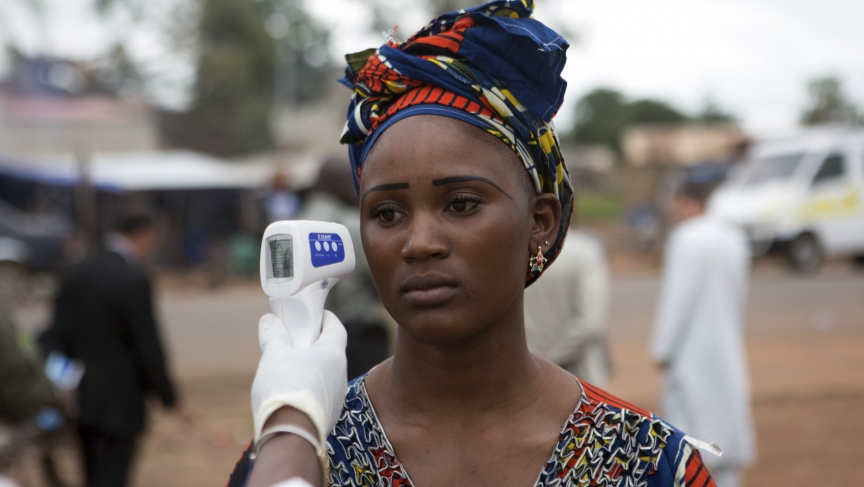
If residents of Ebola-infected areas are allowed to leave with only a fever check, the virus will spread

A woman traveling from Guinea into Mali has her temperature
checked at the border in an effort to screen for Ebola.
(Edited 9-9-2017 to update link to photo)
    I read with some concern recently about the young girl who was carried into Mali while infected with the Ebola virus. One hundred eleven Malians who had exposure to the girl are now being tracked by the World Health Organization.
    As a practical matter the actual number of people actually at risk from developing Ebola from contact with the girl is probably fewer than 30 and perhaps only a dozen. But that's still a lot of people.
    The two-year-old girl apparently never had her temperature checked when entering Mali as she was being carried in a sling on her grandmother's back. She was already ill with Ebola symptoms at the time, and a screening would have detected it.
    What concerns me is that Mali is letting in streams of people from Guinea with only a temperature check to screen for Ebola. The virus has a typical incubation period of 4-21 days (and up to 45 days), so a temperature check is of little use in keeping out those infected with the disease but still asymptomatic.
    My guess is that Mali may already have an Ebola outbreak, authorities just don't know it yet. The nature of Ebola is that there is one death from an unexplained cause, often thought to be malaria or some other malady; three weeks later two or three additional people die; in three more weeks that total might jump to six. It can take two or three months for authorities to even become aware of an outbreak.
    Even when villages might suspect Ebola they might be afraid to alert authorities for fear of being quarantined with no food or having their loved ones carted away. So an initial, isolated outbreak often goes undetected by authorities until a village is completely decimated, perhaps even abandoned.
    Most people have all been indoctrinated with the notion that people should have the right to go wherever they want whenever they want. But no one should be allowed to leave an area with an uncontrolled Ebola outbreak without a mandatory quarantine. Nobody has a right to infect the world.
    The world needs to create a cordon sanitaire around those areas with uncontrolled Ebola outbreaks; nobody leaves without a quarantine. If it requires massive numbers of troops standing shoulder-to-shoulder to enforce, then troops we should send. If the only way to stop people from leaving is to shoot them, then shoot.
    Make no mistake, the developed world should send far more aid to areas affected by the Ebola outbreak. We should send medical help. We should immediately step up and start paying all of the health care workers a risk bonus. We should do far more than we are doing. But we should not allow any potentially infected person to leave the area without a quarantine, period.
    Sadly, the world isn't willing to commit the resources or make the hard choices necessary to control contagion, so Ebola will, in all likelihood, continue to slowly spread. At some point it is likely to spread into rebel-controlled areas of Mali or Nigeria where even Doctors Without Borders has been able to operate with only the greatest of difficulty. Eventually Ebola is likely transform from an epidemic to a pandemic affecting all of the undeveloped world.
    I should note, as I always do, that my views are perhaps overly gloomy. There is evidence that new cases are dropping in Liberia, although some say they are merely going into hiding to avoid cremation. As I have pointed out many times, viruses often burn out of their own accord. Many Africans have developed antibodies to Ebola despite never having been infected, perhaps through exposure to bat saliva on gathered fruit. And the virus tends to spread so slowly that there may still be time to implement a mass-vaccination program.
    I have high hopes for both vaccination and medicines that will be effective against Ebola. As for containment, I fear the battle is either already lost or being lost. Should Ebola become a true worldwide scourge, it won't be from a lack of resources, but rather a lack of will.

Tuesday, October 28, 2014

Pestilence, War, Famine, and Death -- Ebola's story is that of the Four Horsemen of the Apocalypse


--Revelation 6:1-8
    As the Ebola crisis continues to unfold in West Africa we would do well to remember the prophecy of the Four Horsemen of the Apocalypse. And no, I'm not foretelling the end of the world; these horsemen have appeared many times throughout history.
    The meaning of the white horse has been debated, but in recent years it has commonly been called Pestilence, or disease. The red horse is clearly war.
    The black horse is said to symbolize famine and want; but the instruction to spare the oil and wine is a suggestion that the famine's hardship will fall primarily on the poor.
    The pale horse is Death, always a traveling companion to Pestilence, War, and Famine.
    War and Death had already destroyed the infrastructure of West Africa. The reason there are so few doctors and health care workers in Liberia is because they all left or were killed during that country's brutal civil war. And so following in the footsteps of War has been Pestilence -- the Ebola virus. Ebola is also preventing almost all other diseases from being treated, so the death rate is magnified.
    Soon we will have Famine. In Sierra Leone, as many as 40 percent of farmers have abandoned their fields. Presumably a large number have done likewise throughout the region. Trade has come to a standstill and food is already in short supply. These supplies will get shorter still as untended farms produce no crops.
    I've made it clear that I'm more than irritated with the fact that our government has repeatedly given the public false information that the Ebola virus poses virtually no risk to any American and is incredibly hard to catch. This isn't true. But with that said I believe the chances of a major Ebola outbreak in the United States are quite low. It may sound like a quibble, but I object to the government claiming "absolutely no risk" in cases when there is "an overwhelming likelihood that there is no risk." There is a difference.
    But the real Ebola story is in Africa. Unfortunately, I've concluded that based on current efforts the Ebola virus will not be contained; it eventually will spread throughout the undeveloped world. I don't know what the eventual death toll will be, but unless a vaccine is developed I can't imagine that it will be less than 10 million people and could easily top 100 million or more.
    That's a lot of dead people, and even if not a single American dies it will have some major effects on our lives. A recent blog post by Jody Lanard and Peter M. Sandman entitled Ebola: Failure of Imagination sums up my view of the situation quite well. Essentially the authors say that the worst-case scenarios for the Ebola virus are so awful that we are refusing to even contemplate them, and yet by our very refusal to do so are failing to make rational choices that might stave of potential disaster.
    The United States has sent 4,000 troops and various countries are expected to send $1 billion in aid to the region. Certainly this is noble, but it's not going to be enough to stop this epidemic. Perhaps 40,000 troops and medics and $20 billion might do the trick, but there is no national or international will to do this.
    And so Pestilence will very, very slowly continue its march around the globe, often following the Horseman of War. Soon after will come Famine for the poor amid plenty for the rich. And always with them Death.

Friday, October 10, 2014

Ebola growing like the penny in the old childhood allowance puzzle

    I remember as a child reading the Allowance Puzzle, where one was asked to pick whether it would be better to receive an allowance of a dime in January that would increase by a dime every month for a year or an allowance of a penny that would double every month for a year.
    Most children would quickly choose the dime, seeing that $1.20 was quite a lot of money compared to a penny. And they would be wrong. The child who chose to receive a penny for his January allowance would receive $20.48 in December to do his Christmas shopping. That is the power of exponential versus arithmetic growth.
    It is also the story of the Ebola virus, which has been growing in true exponential form for several weeks now: for every person who dies, two new ones are catching the disease. Most of them will die. The Washington Post has a story entitled "The Ominous Math of the Ebola Epidemic," that is scary reading.
    For some reason the "remain calm" crowd keeps telling us that Ebola isn't very contagious. Yet the Spanish nurse who became the first European case believes she contracted the disease when she accidentally or negligently touched her face while taking off her haz-mat suit. This is a description of a disease that is contagious beyond belief. A single touch can result in death.
    I don't know what's going to happen. Perhaps some unknown someone from some unknown someplace will do some unknown something to get this thing under control. Eventually (I hope) we are going to have some restrictions on movement to prevent those who know they might have the disease from just hopping a plane to Dallas. Things in the developed world may grind to a halt for a while.
    Ebola has an incubation rate of a four to 21 days and often comes on quite mildly; figure a fortnight. So what is the effect of doubling a penny 26 times (in other words a year's theoretical growth of Ebola)? I could figure it out but I'm too lazy, but Dr. Math tells us the result for doubling a penny 30 times. If you double a penny 30 times you'll end up with $10,737,418.23. Multiply that by 100 to get the number of pennies and you get 1,073,741,823, or roughly the population of Africa.
    Of course, the growth rate has to slow at some point; everyone isn't going to die. There is sometimes a tendency for a virus such as this one to act like a young fire consuming tinder in a blaze and then dying down. I think there is a better than even chance the virus will be contained with only a few flare ups that need to be tamped down.
    There is also the chance that Africa could see 500 million dead with 500 million addition corpses spread around the rest of the world. And it could be worse. The fact is that nobody can really forecast just how nasty this thing might be, because at its worst it could kill a third of the planet. I don't think it will, but it could. Nobody is going to come out and mention that, except for me. I do think the incredibly slow incubation period of this virus has lulled the public into a false sense of security.
    It is in our national interest to devote substantial resources to fighting this disease. As a nation we need to be prepared for disaster, both collectively and individually. I fear that we are not.


Wednesday, August 27, 2014

In 20-20 hindsight, Jackson Prep player's death was both predictable and preventable

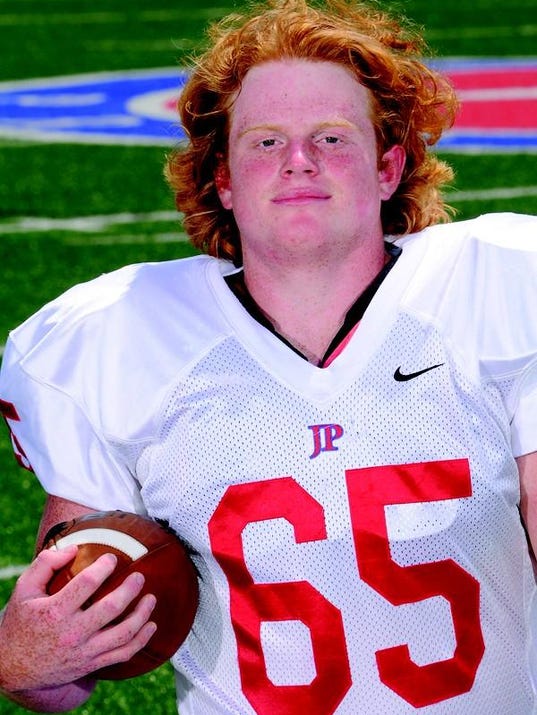
Walker Wilbanks
    The Clarion-Ledger reports that the lead physician who treated Jackson Prep football player Walker Wilbanks said the teens death from a lack of sodium was a "fluke" and "freak" occurance. Wilbanks fell ill during the Friday, August 22 game against Oxford. His death was from hyponatremia, or an extreme lack of sodium.
    "Please don't overreact. Don't let this alter the way you prepare for games," he said. "Friday night was an isolated incident. He couldn't have prepared for it. No one could," Pressler said. "There are times where there are no answers medically, and that's what we're dealing with here."
    I'm not a doctor but I disagree with this one. There are certainly some unanswered questions, such as whether or not Wilbanks might have been taking a diuretic, for example (which can cause hyponatremia), but I'm not willing to accept that such deaths can't be prevented.
    First, I only played football for a single year. I was terrible. But I remember on really hot days the coaches would give us salt pills. My understanding is that salt pills are no longer given. Why? I've never heard of anyone dying from taking a proper dosage of salt pills before a football game, but I now know of one who died because of a lack of salt in his system.
    Second, when football players practice and play in extreme heat bad things, including the possibility of death, are more likely to happen. The high temperature at the Jackson airport on August 23 was 93 degrees. At 6:53 the temperature was 90 with a heat index of 95.4. These temperatures were recorded on the outskirts of the city, and are likely lower than those that existed on the Jackson Prep field. I think it is obvious that had temperatures been cooler Wilbanks would be alive today.
    Following the death of a football player to heat stroke the state of Kentucky adopted rigid rules concerning practices in heat. With a heat index of 95 or above the following steps are required:
 Provide ample amounts of water. This means that water should always be available and athletes should be able to take in as much water as they desire.
 Mandatory water breaks every 30 minutes for 10 minutes in duration
 Ice-down towels for cooling
 Watch/monitor athletes carefully for necessary action.
 Contact sports and activities with additional equipment
 Helmets and other possible equipment removed if not involved in contact.
 Reduce time of outside activity. Consider postponing practice to later in the day.
 Re-check temperature and humidity every 30 minutes to monitor for increased Heat Index.
    Unlike a practice, a football game doesn't allow 10-minute water breaks every half rour. Players can't always remove their helmets. And the outside activity can't be reduced or postponed.
    But there is a solution: Don't allow football games in August!
    School traditionally began the Tuesday after Labor Day, with the first football game perhaps the Friday after Labor Day. Labor Day marks the end of summer for a reason; temperatures drop with every passing day.
    I don't blame anyone for Wilbanks' death. But in hindsight it wasn't a "freak," unpreventable occurrence. It was predictable and preventable. We need to attempt to discover as many facts as possible and work together to prevent such deaths in the future.
    We can prevent future deaths by banning August football games and by making sure players have a high enough sodium level, whether it's achieved with salt pills, energy drinks, or something else. As a state we need to regulate football practice conditions as well. These changes can come from the athletic associations or from the legislature; I don't care which.
    As a state we have a choice. We can make some changes, or we can decide to bury some more teen-agers. Because when another kid dies, it won't be a "fluke." It will be because we allowed it to happen.

Tuesday, August 26, 2014

As the government tries to ban salt from our schools, study shows eating salt promotes good health

    In the "why we need less federal government intrusion" department, a new study finds that reasonable or even slightly high levels of salt in the diet do no harm. In fact, the most dangerous sodium intake level is the very-low-salt diet, such as the one the government is forcing on our school children.
    Schools across the nation have been scrambling in an effort to meet federal demands that school lunches have ultra-low-sodium. Aside from making food taste good, salt is an important ingredient that improves both texture and shelf life of baked goods.
    School lunch prices for full-pay students have skyrocketed this year, pursuant to federal mandates that schools serve unhealthy meals low in sodium. We are -- as is always the case with the federal government -- paying more to get less.
    Some people, such as those with high blood pressure, should limit salt intake. But for the rest of us, salt is good food.

Friday, March 14, 2014

When patients fail to pay their Obamacare premiums health care providers are left holding the bag

    The important thing to understand about Obamacare is that virtually everything is broken. It's a bad, poorly thought out law.
    It had to be, by the very nature of it. The Democrats rammed it through Congress as part of a reconciliation bill. Even the people supporting it had little idea what they were voting for. Nancy Pelosi made headlines when she explained that the bill would have to be passed before people would really understand what was in it.
    The American people are starting to understand and many simply do not like it.
    One little feature of Obamacare is that anyone purchasing subsidized insurance is automatically covered for four months after making a single payment. In other words, there is a 90-day grace period before policies are cancelled.
    I suppose that is something that can be priced into insurance. But what happens next is the shocker.
    During the first 30 days of the 90-day grace period insurance claims will be paid and processed. Any claims during the next 60 days simply will not be paid unless the premiums are paid.
    So doctors and hospitals will be told that a patient is insured, only to find out later that they aren't going to be paid.
    Obamacare already has really low reimbursement rates for doctors. In California, for example, a majority of doctors are simply refusing to see those insured through exchanges. They can't afford to. Refusing to pay doctors and hospitals for services provided is going to make them even more loathe to accept exchange insurance.
    Failure to pay premiums is a big problem with Obamacare. The administration has been trying to hide the numbers, but roughly 20 percent of those who signed up never paid their first premium, and that may be a low number. So instead of 4.2 million being enrolled through the exchanges the number is more like 3.3 million or fewer. If 20 percent of this number eventually defaults on their insurance payments, then roughly 600,000 people will be able to run up doctor and hospital bills under the guise of being insured. Providers will be falsely told that their patients are insured only to find out later that they are being stiffed.
    No doubt many people are going to be upset over the fact that they've paid for insurance and can't find a doctor to accept it. How bad is the problem? Well, it depends on the state. Forbes did an analysis of the availability of specialists and found substantially fewer participate in Obamacare.
    The chart at right shows specialist availability offered by Athen in its PPO plans versus its Obamacare Bronze plans. In some cases the differences are extreme. For example, Anthem PPO customers in Indiana have a choice of 1055 cardiologists to choose from in their plan. Obamacare customers have 74. In other words, only one in about 14 doctors in its regular PPO plans are willing to accept Obamacare patients.
    Anthem was chosen for the comparison because the data was readily available, and its exchange plans tend to be as good or better than most.
    Understand that President Obama has declared policies which don't cover things like maternity care for senior citizens junk. But most Americans would prefer to pay less for their insurance, forego the free birth control they don't need, maternity benefits they don't want, and so forth, and instead have a wide choice of doctors who would be glad to see them.
    Roughly half of American doctors aren't going to accept Obamacare, and that number is likely to rise after they don't get paid.
    Even worse, because of all the money being spent on Obamacare there is no money to pay for the annual Medicare/Medicaid "doc fix," which increases reimburse levels for these programs. Doctors are about to take a 24 percent pay cut and many will respond by refusing to see Medicaid patients.
    So the problem isn't limited to just purchasers of junk Obamacare policies. Soon Granny won't be able to find a doctor, either.
    Thanks Obama!

Thursday, March 13, 2014

A single chart shows how doomed Obamacare relies on the victimization of young males to succeed

This chart shows what a really bad deal Obamacare is for males of almost any age. Roughly 50 percent of the premiums paid by young males go to women and wealthy older insurance customers. Note the bottom portion of the chart, which shows that older customers receiving giant subsidies are signing up at roughly twice the expected rate while young people have signed up at about half of what was expected and needed.

    It should be apparent by now that the government's attempt to take over and micromanage one-sixth of the American economy is a complete and total flop. Obamacare will fail, and it should fail. The chart above, from the ACA Death Spiral website, shows why.
    One of the myriad faults with Obamacare is that it limits or outlaws all insurance ratings, save for those based on geography. Age ratings are permitted in part. Older patients cost as much as five times as much to insure as younger ones, but Obamacare imposes a 3:1 maximum premium differential. In other words, young people just starting out in life are forced to subsidize their wealthier elders.
    Oddly enough, liberals don't seem to care about premium differentials when it comes to auto insurance. The differential is often huge: young males pay premiums several times those of older females. If we are going to limit age differentials in insurance, shouldn't we do so for all types of insurance? Shouldn't we require all citizens to purchase auto insurance, whether they own a car or not?
    The chart above shows that roughly 50 percent of premiums paid by younger males will go to provide free insurance coverage to other groups, a subsidy being a form of free care. Consider the fact that 20 percent of insurance benefits are actually overhead costs and young males as a group will receive only 40 cents of medical care for every dollar in premiums paid.
    But wait there's more! I'm operating on guesstimate here, but we've all observed that in any group the bulk of medical costs are incurred by a relatively small number of individuals. Using a proper rating system I dare say that out of a group of 100 men I could identify 10 up front who would be likely to consume 50 percent of the group's medical services over the next year.
    Technically insurers are allowed to charge a smoker's premium under Obamacare. But those who lie won't have their policies cancelled or coverage denied. With Obamacare, those who engage in risky health behaviors now have their costs passed over to the healthy. So the Type 2 diabetic who weighs 300 pounds, drinks like a fish, and chomps on pork chops and pies all day won't have to pay a dime in extra insurance costs. His costs are covered by gouging vegetable-eating joggers.
    I suspect that when you factor out the costs of the intentionally or unfortunately ill, you'll find that young, healthy males will receive less than 20 cents in health-care benefits for every dollar paid in premiums. For young males -- and males of most ages really -- Obamacare is a sucker deal.
    The Obama administration has been in an all-out effort to get young people to sign up for Obamacare. And many administration officials have been up front about why these younger signees are needed: to subsidize health care for those being sold discounted health plans. The president is actually making (bad) comedy videos in an effort to woo the young.
    But these Obamacare shills have a terrible sales pitch. It's essentially, "Hey young people, come sign up for insurance so we can charge you four times as much as we should and use the money to give free coverage to people who are older and wealthier than you!" Many young people will qualify for health-care subsidies when purchasing low-quality policies through the exchanges, but unless these subsidies equal 75 percent of their premiums it's a bad deal.
    Suppose you were to go to a restaurant and be told that your $25 meal would cost $125 in order to provide everyone with unlimited fine wine with dinner. This might be a good deal, except for those who are satisfied with a $5 glass of wine, or no wine at all. Soon such a restaurant would find that teetotalers and cheap-wine drinkers would stay away, and it would quickly go broke as its changing customer base slurped down vast quantities of Cristal, Château Petrus, Opus One, etc., for the low price of $125 per meal. Would you go to such restaurant? I wouldn't.
    Of course, with the Obamacare mindset such a restaurant needn't go broke. The government would just agree to cover the tab of any patron who drank too much expensive wine and pass on the costs to the taxpayers. But is this a rational government policy?
    Should young males buy health insurance? Perhaps. They should base their decision on their own best interests and not on some stupid comedy skit by the president. If they are dreadfully ill, of course they should buy the now-partially-free insurance. If they have a substantial estate, yes. But for the average male with a modest estate a better choice is probably to buy plenty of accident coverage on one's auto policy and hope for the best.
    Yes, bad things can happen, but uninsured young people can get emergency health care. If a chronic condition should surface they can wait a few months and enroll in Obamacare. And if their bills are just impossible to pay off they can declare bankruptcy and get a new start. This is the best choice young males have under Obamacare, and it's the one most are taking.
    Maybe more young people could be persuaded to sign up, if only they could be shown videos like the one made by Richard Simmons, as part of the "Tell A Friend -- Get Covered" campaign (shown below). Please watch this video, young males of America! Doesn't it make you want to pay four times as much as you should to "Get Covered"?

Tuesday, December 10, 2013

Parlez-vous Serbo-Croatian?

    I was poking around on my insurance company's website and found a feature that would identify doctors able to deal with patients speaking foreign languages.
    Apparently Oxford has two (or maybe only two within my plan). One doctor can handle French speakers and one can handle those speaking Serbo-Crotian. As for Spanish, nada.

Wednesday, October 23, 2013

If you are really, really sick you need to hire a doctor to hire your doctor

    Internet blogger Steve Sailer occasionally creates national talking points by writing things that mustn't be written. Others then repackage his views and either repeat them in gussied-up form or else denounce his ideas without referencing exactly what they are denouncing.
    For example, he opined in 2005 that the difference between Red States and Blue States was that in Red States "Affordable Family Formation" was possible. In other words, in Red States it was generally possible to get married, have children, buy a house, and send children to public school. He Googled the phrase and found not a single instance of this phrase having ever been used in the history of the Internet. Google it today and you will get 44,300 hits.
    He's written a few posts over the years about being cured of non-Hodgkin's lymphoma in 1997. The most recent item was in response to a New York Times opinion piece which pointed out the fact that people need to take control of their medical treatment, because doctors do get things wrong.
    I'll cut to the chase. Sailer's advice to anyone suffering a serious illness is this: Hire a doctor to hire your doctor. In 1996 he hired an oncologist as a consultant to choose between three different doctors with three different treatment proposals. Because of this he was one of the first people in the country -- if not the first -- to use a new drug that has been found since then to be highly effective. He credits his decision with saving his life.
    A personal example: A few years ago my father got a call from one of his doctors telling him that they had his blood tests and that his potassium levels were dangerously high (high potassium can cause a heart attack). They told him not to eat any bananas, tomatoes, or other foods high in potassium and to come in first thing Monday morning (it was late Friday). That was it.
    When I heard this I immediately did a web search on all of his medicines and found that an alpha blocker he was taking for blood pressure was associated with high potassium levels. His blood pressure problem wasn't all that serious, so I had him discontinue the alpha blocker until his consultation, at which time the doctor ordered it dropped as well.
    I didn't do anything the nurse couldn't have done better. But if I hadn't done it then it simply wouldn't have been done.
    Two years ago I wrote about a simple genetic test that most of us have already taken that could save your life. The test to answer the question, "How does dextromethorphan (Robitussin DM) make you feel?" I don't know of any doctor who asks that question. As a result, these doctors are mis-treating three to seven percent of their patients, risking potentially fatal consequences.
    When it comes to medicine, your health and life demand that you do some research on your own. And if you are really sick, hire a doctor to hire your doctor!

Monday, October 3, 2011

A nearly free genetic test that just might save your life

    Today I’m going to tell you about a nearly free genetic test that could save you a lot of medical grief and in rare instances might even save your life. In fact, chances are you’ve already performed this test on yourself, you just don’t know what the results mean.
    As always, my disclaimer: I’m not a doctor, although I play one at cocktail parties.
    Everybody loves a story about someone else’s grief and misery, so I’ll share mine. Several years ago I saw a weight-loss ad in the paper and decided to go see a fat doctor, who I will call “Dr. Aflac.” For any of you who might be hard of thinking, what’s the Aflac duck say? Quack, quack!
    Dr. Aflac prescribed me phentermine, generic Prozac, and pig thyroid for weight loss which makes sense. Prozac, an SSRI, does promote weight loss for some patients, although not as effectively as the banned fenfluramine. Phentermine, a mild stimulant, has long been known to cause weight loss. And thyroid supplements will increase metabolism, although the body tends to resist efforts to increase thyroid levels by reducing production.
    The drugs were effective, but after a week I started having trouble sleeping and my legs and arms would have spasms, particularly at night. After two weeks it was much worse, and I could only get to sleep by taking some Ativan, which I had in reserve for airplane rides.
    I reported my problem to Dr. Aflac and he assured me it would go away, and that Prozac never caused these types of problems. So I continued two more weeks. By this time I was totally sleepless and could not hold a fork steady enough to get it to my mouth. I had to hold a drink cup with two hands.
    I must say I had lost some weight, though. The inability to keep food on one’s fork is highly conducive to the loss of weight.
    At this point I decided to take my case to the Internet, where I soon found that Prozac is processed by a liver enzyme known as CYP2D6. Somewhere between three and seven percent of the white population suffers from a severe deficiency of this enzyme. I suspect I produce virtually none of it. At the other end of the spectrum are a few people who produce a lot of this enzyme.
    It’s possible to take a genetic test for the CYP2D6 enzyme. These tests can cost hundreds of dollars. If you don’t want to spring for a test right away, you can just ask yourself one question: What do you think of and how much do you like dextromethorphan? That’s the drug in Robitussen DM. Chances are if you take a good slug you either hate it, feel nothing or perhaps find it mildly pleasurable, or absolutely love it.
    If you really love dextromethorphan you are an ultra-metabolizer and have a lot of CYP2D6. It is from this group that people who use dextromethorphan as a drug of abuse come from. So if you have heard of someone “Robi-running” and asked yourself “Why?”, the answer is because they are getting something from the drug that most people don’t.
    If DM is only slightly pleasurable to you, or not particularly pleasurable at all that’s good news. It means you’re normal, and a whole bunch of drugs are going to work for you just like they are supposed to work. Congratulations.
    If you hate dextromethorphan it is likely because you are a poor metabolizer and have little or no CYP2D6. On a personal level, it makes me feel too bad to stay up, but I can’t go to sleep either. My brain feels likes it’s laying atop a razor blade. Ouch!
    So what does all of this mean and why is it important to you? Well, if you have little or no CYP2D6 dozens of drugs – as many as 25 percent – simply aren’t going to work properly for you. In some cases there will be only a slight loss of efficacy, but in others it can be dangerous. When the doctor prescribed me Prozac for weight loss, my lack of CYP2D6 meant that the drug wasn’t being broken down and removed from my system. Not only wasn’t the drug not working exactly properly, but it was building up in massive amounts because by body couldn’t break it down. Codeine, as a cough syrup, is absolutely ineffective on those without CYP2D6, as the body can’t convert the codeine into the morphine which actually suppresses the cough. (Hydrocodone uses CYP2D6, but provides some but lessened effect in those who don’t have the enzyme). SSRIs don’t break down properly without CYP2D6; a few, such as Paxil, can be downright dangerous. Tamoxifen, the breast cancer hormone drug, doesn’t work well or at all without CYP2D6. Obviously knowing whether or not one has the enzyme to process this drug is pretty darn important when deciding on a cancer treatment.
    Many doctors are amazingly unaware of the important of individual liver enzyme profiles in the treatment of patients. I’ve never had one ask me how I felt about dextromethorphan, and I suspect few know of this shortcut to expensive genetic testing.
    Make no mistake, if your life depends on getting the most out of a particular medicine you ought to pay for genetic enzyme profiling. But everyone’s health could be much improved if they would ask and consider their answer to one simple question:
    How does dextromethorphan make you feel?