Showing posts with label history. Show all posts

Monday, June 22, 2020

New film portrays whites as slaves and blacks as owners, but there is no need for fantasy world

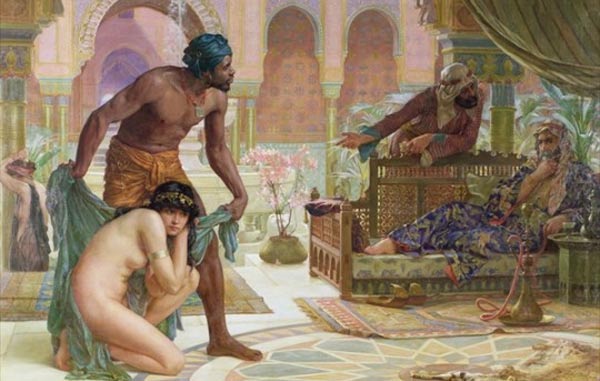
A European woman being sold in an African slave market
    In the spirit of the times a new movie, called “Cracka,” features blacks as slave owners and whites as slaves. I rarely watch movies but do get a bit of sad amusement out of the crap that is being produced these days.
    What I find odd is that the movie is based in the United States instead of Africa, where more than a million whites were enslaved by Africans. In comparison, approximately 388,000 Africans were brought to the American colonies or later to the United States. Although the slavers were North African, many were what we would consider today as black.
    The bulk of the kidnapings began in the 1500s and continued until the United States, tired of its citizens being kidnaped and sold into slavery, defeated the Barbary States in our nation’s first war, fought from 1801 to 1805. The defeat of these slaver states ended with the American flag being raised over Tripoli, a fact commemorated by the Marine hymn which includes the phrase “to the shores of Tripoli.” The United States again used military force against the pirates in 1815.
    There is no need for some masturbatory fantasy flic about whites being slaves to blacks. White slavery is a historical fact. Stories based on or incorporating true facts almost always have more impact than made-up fantasy films. We need a film showcasing the lives of white slaves and their black owners, but “Cracka” doesn’t pass muster at all.


Saturday, April 25, 2020

Elections have consequences; many Democrats have promised to bring back forced busing

These Charlotte, N.C., students are being forcibly bused into the inner city to attend school in 1973. What an incredibly unpleasant experience!

    It's easy to forget that we're in the middle of a presidential campaign. On one side we have Donald Trump, a loudmouth who always says the wrong thing but usually does the right thing. On the other we have a completely senile Joe Biden, who has been pushed far to the left by a Democrat party that is now an uneasy alliance of America's fringe groups.
    During the primaries virtually all of the Democrat candidates said they supported greater federal efforts to desegregate schools; many stridently advocated for forced busing, one of the most unpopular edicts our courts have ever imposed on the American citizenry. The definition of "segregation" has somehow been changed so that it applies to any school or program whose enrollment doesn't exactly reflect the surrounding population. For example, a highly competitive New York City school with a 30 percent white population has been described as "segregated" because only 15 percent of that city's public school students are white. The only real way to achieve the desegregation goals these leftists hold dear is through forced busing over very long distances.
    Busing, like communism or socialism, works in the short term. But in the long term it's pretty ineffective because people just move away; the same is true of other radical desegregation efforts. Leftists lament the 1974 Milliken v. Bradley, 418 U.S. 717, busing case in which the Supreme Court chose not to force busing on innocent children whose parents or school districts had never discriminated against anyone. The leftist view is that it is perfectly okay for children to be forced to spend hours on a bus every day being carted across two or more counties in order for schools to have perfect racial balance.
    I required my children to ride public school buses either to or from school for a few years. They are adults now but have made it clear that what I did was a moral wrong. School buses are just unpleasant and children who have less are often mean as snakes to those who have more. My kids finally impressed on me the importance of my dropping them off and picking them up for school. Their physical and mental well-being demanded it.
    In Oxford it took my kids almost 70 minutes of bus-riding time to get home. I wanted to let them take the bus from home to school but found they would have to get up every morning before 5 a.m. in order to catch a 6 a.m. bus to school. That's just too much. Of course, if they had been subject to some sort of Democrat busing scheme they would have had to spend four or five hours every day being carted to some school district in a neighboring county. It's just ridiculous, and people who support forced busing are truly evil.
    The photo at the top of this post shows innocent children from suburban and rural areas around Charlotte, North Carolina being forced to ride unpleasant buses taking them to and from that city's inner-city schools. Notice how extraordinarily crowded this bus is! No child should have to endure that, or at the least they deserve to be paid a high hourly wage for their suffering. Democrats effectively turned these children into uncompensated slaves, but of course the Democrats have always been the party of slavery.
    And could there be a greater vector for the transmission of disease than these dreadful school buses? If Democrats have their way Americans kids are going to be herded onto these buses by the millions, thus ensuring massive transmission of the COVID-19 and other viruses. They don't care how many millions of Americans get sick or die from their forced busing schemes so long as they are allowed to engage in their grand social-tinkering.
    Americans have a choice. We can elect a senile old man whose controllers are going to force our nation's innocent school children to spend hundreds of millions of hours on unpleasant school buses, all so they can be forced to attend schools in slum areas. Or we can vote for Donald Trump.
    It's a simple choice of good versus evil. Those who are evil can support Biden. Those who are good can support Trump. For me, and for anyone with children or who remembers raising children, the choice is easy.

Sunday, November 24, 2019

Before you throw away that faded photo, try scanning, editing it in Photoshop first

Unedited photo scan from Photoshop

All I did was hit "auto" contrast and levels and this photo was saved!

    I recently came across some old photos and have been trying to figure out what's what. One of the photos was so faded in various shades of sepia that I really could make much out. I decided to go ahead and scan the photo and open it in Photoshop to see if I could tweak it a bit.
    I really didn't do much "tweaking." I just hit the auto-contrast and auto-levels and suddenly a photo in which nothing could be seen became much, much clearer. I did make a point of scanning at 400 dpi, which is a little higher resolution that the typical photo scan. So if you have an old photo that looks like it has just faded away, try scanning it and hitting auto-adjust in Photoshop before you throw away that little piece of history.
    I still don't know what the photo is, but I think the woman in the shawl standing in front is my great-grandmother, Margaret Watkins Hurdle. I've seen photos of her wearing a shawl in that fashion before.
    ADDENDUM: Even if it is an old black and white photo that has faded into sepia, scan the photo in color. This provides far more information to aid Photoshop in bringing out the image. After editing it, if you want to convert to grayscale, fine.

Friday, April 5, 2019

The Holly Springs City Cafe: Gone but not forgotten

    I was thinking about the Holly Springs City Cafe the other day. It’s said we don’t appreciate things until we don’t have them any more, and that’s certainly true of the City Cafe.
    I’m not sure how old I was when I first remember going to the City Cafe. I would guess 9 or 10. Cokes were served in 6.5 oz. bottles along with a glass of ice. I was always a little frustrated by the small bottle size, but at the same time the Coke from the smaller bottles seemed to taste better. They used to say they put the same amount of syrup in the 6.5- and 10-ounce bottles.
    The City Cafe was owned and operated by Juanita Jones. She either inherited it or owned it jointly with her late husband, who I think might have been named Ed. He was quite a bit older than her, which says something since I don’t remember her being that young. I don’t remember him ever saying anything. He just said at the cash register and took money. I think Mr. Jones died around 1975.
    There aren’t many restaurants that offer fresh vegetables, but the City Cafe did most days. They would buy them from local growers who would drop them off or perhaps off the back of the many pickup trucks that used to park across from the Post Office. I haven’t seen a pickup with produce for sale in quite a while; not sure what happened to the fresh vegetable supply.
    Most of the pies that were offered for dessert were homemade, or restaurant-made anyway. The late attorney John Kennedy would always ask when the pie was made and it was always “Made fresh this morning.” This really wasn’t true as sometimes the pie was a day or two old; it took some detective work and careful interrogation to ferret out which pies were truly just made. I don’t like coconut, but I remember liking Juanita Jones’ coconut pie.
    My junior year in high school I arranged my class schedule so that I could leave school at noon and work at my dad’s office. A few people have engaged in a campaign of lies and innuendos against me by suggesting that perhaps I didn’t expend too much effort on the job. Don’t believe them!
    I do remember that my work day almost always began with lunch at the City Cafe, sitting at the back table with Dad, John Kennedy, Ralph Avent, Hamlet Yarbrough and his cotton buying partner Mr. Allen, along with a host of others who joined in on an irregular basis.

  • Keeping up with the conversation was a bit like trying to follow a game of Ping Pong. Somebody might mention almost hitting a deer on the way to work; another might mention they heard Thus-And-So got in a wreck; etc., etc. with the subject changing every minute. One day Ralph Avent declared “I could have killed two this morning” to everyone’s puzzlement. You see, at the start of the conversation somebody had mentioned almost hitting a deer; the conversation had moved on, but Ralph hadn’t.
  • Ralph had the same order every day: “I’ll have what Sidney got.” One day my dad ordered and Ralph turned to him and said, “Sidney, you know I don’t like turnip greens!”
  • Mrs. Jones was slightly hard of hearing and would repeat everything you said, changing only the pronoun. If you said, “I’d like the pork chop and mashed potatoes,” she would start writing the ticket while saying in a fairly loud voice, “You’d like the pork chop and mashed potatoes.” One day my brother Lanier found a worm in his squash – a hazard when using fresh vegetables – and very quietly pointed out to Mrs. Jones that there was a worm in his squash. Mrs. Jones responded: THERE’S A WORM IN YOUR SQUASH! So much for being discreet.
  • The City Cafe always had French fries that were nice and crunchy and done. They had a great hamburger and a really good club sandwich, which cost $3.50 with fries included. One day my dad lavishly complimented Mrs. Jones on her fine sandwich by telling her that he had paid $6 for a club sandwich at the Cincinnati airport the day before and it wasn’t nearly as good as her club sandwich; he spent quite a bit of verbiage in telling her how fine her sandwich was. The next day the price of the club sandwich was increased from $3.50 to $6.
  • If someone got a dessert that was particularly good, a friend might ask for a taste. My dad never did that. On the other hand, if someone declared that something tasted awful, Dad usually said, “Lemme see.”
  • One day the conversation made me think of a joke I had read in a men’s magazine. It was a clean joke, mind you, so I threw it into the fray. John Kennedy, sitting at the other end of the long table turned and said in a loud voice, “So, you read Hustler, too!" My 15- or 16-year-old face got pretty red after that.

    The City Cafe had a fine breakfast as well and different time slots would draw a different crowd. There was always a big crowd for breakfast, a smaller crowd mid-morning, then a big lunch crowd for about 90 minutes, and then a small crowd around 3 p.m. This was before the day of coffee places on every corner, but the City Cafe had Starbucks beat. And their iced tea was always perfect.
    Perhaps I’ll think of some more stories later on, but I sure do miss that place!

Monday, August 28, 2017

Global warming isn't making storms worse, but coastal population density is

There was a time when our coastal areas were sparsely populated.

    The damage, although not the death toll, of Hurricane Harvey may outpace that of Hurricane Katrina. You can expect the Global Warming crowd to cite this as "proof" that global warming is making things worse.
    Virtually everything gets blamed on global warming. Facts, of course, are not important. Click here to see a chart that identifies every hurricane known to have reached U.S.  landfall since the 1850s. It's not considered accurate for its earliest years because many hurricanes were not identified due to sparse population.
    You will note that the past 10 years have seen below-average hurricane activity. And  the 1940s, when global warming was a mere gleam in Albert Gore Sr.'s eye, were a time of frequent and powerful hurricanes.
    What has changed is that more and more people are moving into areas that are prone to highly destructive hurricanes. In the 1940s Florida claimed about two million residents and Monroe County, Fla., home to Key West and Key Largo, had about 15,000. In the 1940s the Bogart and McCall movie Key Largo featured at a nearly abandoned hotel, which was quite realistic for the time.
    Today Florida has a population of more than 18 million and the population of Monroe has grown to almost 80,000. Most of Florida's population growth has taken place around Orlando and in coastal areas. The map at the top of this post shows the population density of the Southern Atlantic Seaboard. It's the same story all over Florida, with most people choosing to live near the water -- and in the path of deadly hurricanes.
    Conjure up an image of a Florida beach house and you likely think of a very simple structure;  many years ago such houses were built with the knowledge that the Big Bad Hurricane Wolf might come and blow the house down. Today expensive homes are built with wild abandon along all of our coastal areas, subsidized by cheap federal insurance. The results, in terms of property damage and the loss of human life, can be catastrophic.
    Florida's story is repeated all over the nation. In 1940 the city of Houston, Texas had fewer than 400,000 residents; today there are more than two million. Some of that increase is doubtless due to annexation, but the area is far more densely populated than ever before. The results when disaster strikes are easily predictable.
    So the next time you hear somebody prattle on about how massive damage from storms is caused by global warming, point out that the leading cause of this damage is the decision by tens of millions of people to build and live in harm's way. Perhaps, as a matter of public policy, we should discourage such development, or at least not have the government subsidize it so much.

Friday, August 18, 2017

Preservation of slavery a major reason Southern colonies supported American Revolution

    A little history lesson. A number of Southern states decided to join America’s civil war in order to preserve slavery. It’s a fact.
    But do understand that the terrible conflagration that occurred between 1861 and 1865 was not a civil war as most people understand the term. It was truly, as Southerners, refer to it, as a War Between the States. The Confederacy had an organized government, a legislature, a judiciary, an executive, and 11 sovereign states that also had fully organized and fully functional governments. These things do not exist in a civil war.
    America’s civil war didn’t take place from 1861-65. It took place from 1775 to 1781. We refer to it as the American Revolution, but in fact the Revolution has all of the characteristics of a civil war, among them a poorly organized government and little geographic division between opposing sides.
    Most people are under the impression that the War Between the States was fought for the purpose of freeing the slaves. Far from it. Abraham Lincoln sought the passage of the Corwin Amendment during James Buchanan’s lame duck period, which would have enshrined slavery into the Constitution forever.
    Lincoln wrote to the governors of the seceding states providing copies of the Corwin Amendment for them to consider, it being his opinion that they were still a part of they Union and therefore their legislatures could vote to ratify. The Southern states were not interested, because there were so many other conflicts with the North; the South simply did not wish to be a part of the Union, even if slavery was guaranteed. The forced abolition of slavery simply was not on the table in 1861.
    Things changed after several years of war, and Lincoln eventually signed the Emancipation Proclamation (which had no immediate effect, since it only applied to areas not under Union control), but the important thing to understand is that what is commonly called the American Civil War simply was not fought for the purpose of freeing slaves. It happened afterwards, but it was not the intention of the North at the outset.
    Enough of that. Let us go back to the American Revolution. Unlike the Northern colonies, the Southern colonies were fairly happy with relations with Great Britain. Sure, they had gripes, but most Colonists were loyalists. But they were dealing with what amounted to a massive slave rebellion.
    Word had spread among the slave population of Great Britain’s inclination to abolish slavery at some point. A British court had set free a Jamaican slave who had been brought to England in what was known as the Sommerset Decision, and although the court decision was intentionally limited, most American slaves believed – incorrectly – that if they could somehow reach British soil they would be freed. Slaves were starting to run away and there had been rebellions.
    In November 1775, with the Revolution breaking out, Virginia’s last British governor, Lord Dunsmore, offered any slave willing to fight for the crown their freedom and land to farm; he had already threatened the Colonists that he might free the slaves in April 1775 should any harm come to Williamsburg. Meanwhile, Revolutionary recruiters in Georgia and South Carolina were promising white soldiers a slave at the end of their service. Needless to say, Colonial slaves saw where their best hope for freedom lay and acted upon it.
    In South Carolina, two-thirds of slaves escaped following Dunsmore’s proclamation. Thirty thousand slaves fled Virginia. Although fewer than 1,000 former slaves actually served the British as soldiers, at least 20,000 defected or allowed themselves to be captured and many served in other capacities. By the end of the war, out of a total slave population of 450,000 in the colonies, approximately 100,000 had escaped, died, or were killed in battle.
    At the conclusion of the war Great Britain resettled approximately 12,000 of the former slaves in Nova Scotia and the West Indies. About half who settled in Nova Scotia eventually chose to resettle in Sierra Leone. However, Britain returned escaped slaves to former owners who had remained loyal to the crown.
    Near the outset of the war George Washington allowed free blacks with military experience to join the Continental Army. A year later he expanded that to include all free blacks. Soon after Congress voted to allow slaves to serve, but no Southern state agreed save for Maryland.
    Approximately 5,000 blacks, both free and slave, served in the Continental Army. Many slaves were given their freedom, but others who had been promised freedom were instead returned to slavery.
    Lord Dunsmore’s actions obviously backfired horrendously. His intention was to frighten Southerners away from joining in what was mostly a Northeastern rebellion. Instead he caused many Southerners who would otherwise be loyal to the Crown to join in the Revolution. Slaveowners joined to protect their economic interests, and the intensely Loyalist backcountry residents of Virginia and the Carolinas were frightened at the thought of tens of thousands of armed former slaves roaming the countryside and switched their allegiance to the Continental cause.
    Our high school history books don’t tell this version of events because victors like to paint themselves in the most flattering light possible. We live in a world of myth, and there’s nothing wrong with that. Perhaps most of those who joined in the American Revolution did so in pursuit of the high-minded ideals stated in the Declaration of Independence. But in the South many were motivated, at least in part, out of a fear of abolition and a desire to maintain legal slavery.
    So the bottom line is that the war many believe was fought to end slavery wasn’t; and the American Revolution, with all of its high-minded ideals, was also fought by some to preserve slavery.
    Those who insist on denouncing those who served the Confederacy while praising those who served in the Revolution need to delve a little deeper into America’s not-always-pretty history. Life is complicated.
________________________________

Sources: Was the American Revolution Fought to Save Slavery?

INSTITUTE INDEX: Slavery and the American Revolution

Dunmore’s Proclamation
How fears of a slave revolt drew the South into the war—the Revolutionary War

Tuesday, August 15, 2017

In 1942 Congress changed the flag code because our salute looked just a little too Nazi-like

Schoolchildren using the Bellamy salute prior to 1942.

    There was a time when Americans saluted the flag with their right arms stretched out. The stiff-arm salute was known as the “Bellamy Salute,” as it was created by the author of the Pledge of Allegiance, Francis Bellamy.
Francis Bellamy
    Bellamy, an extreme socialist, wrote the pledge in the 1890s with the idea that it would encourage patriotism for schoolchildren to recite it every day. The Bellamy salute was intended to be non-militaristic. In the photo above, the schoolchildren have their palms facing upward. When properly executed, the palm should vertical. I’ve seen a number of photos and videos of schoolchildren reciting the Pledge with their palms facing downward, identical to the Nazi salute.
    It was this similarity to the Nazi salute that caused Congress to modify the Flag Code in 1942 to change the salute to the flag to the hand being held over the heart. I’ve seen several photos, probably taken right after the change, that show children with their hands over their hearts in a “salute” position rather than flat over the heart as practiced today.
    It is unfortunate that almost any politician who waves at a large crowd is at some point going to give a wave or salute that looks similar to a Nazi salute. Extreme bodybuilders have trouble fully straightening their arms, and perhaps politicians should make a point to wear an elbow brace to keep their right arm from extending all the way out lest their opponents use the opportunity to portray them as a Nazi.
Edward Bellamy
    My father mentioned to me years ago a book by Francis Bellamy’s brother, Edward, called Looking Backward 2000-1887 (free on Kindle). It’s a Utopian, Rip-Van-Winkle-style novel that he was assigned in college by his favorite professor, Jim Silver, in which a man wakes up to find an America vastly changed from the dog-eat-dog capitalism of 1887. Both Bellamys were quasi-Communists, but the book nevertheless has some amazingly spot-on predictions and interesting observations.
    For example, the book describes a type of credit card, and a shopping system where all goods could be reviewed and delivered overnight by pneumatic tube (in fact, I think such a system was used by the French postal system in Paris); sort of like today’s Internet shopping. Radio had not been invented at the time the book was written, but Bellamy envisioned a wired (cable!) system that would allow people to listen to 25 stations, including some of the finest concerts, in their homes.
    In Year 2000 Boston umbrellas have become obsolete. Our Rip-Van-Winkle protagonist, Julian West, is surprised to discover that the streets have covers that are extended when it rains, thus eliminating the need for an umbrella. His modern-era companion, Edith Leete, expressed a bit of skepticism as to whether streets were ever full of people holding individual umbrellas. I found the passage interesting, certainly reflective of Bellamy’s ideology, and thus share a few paragraphs (emphasis added):

    . . . I was much surprised when at the dinner hour the ladies appeared prepared to go out, but without either rubbers or umbrellas.
    The mystery was explained when we found ourselves on the street, for a continuous waterproof covering had been let down so as to inclose the sidewalk and turn it into a well lighted and perfectly dry corridor, which was filled with a stream of ladies and gentlemen dressed for dinner. At the comers the entire open space was similarly roofed in. Edith Leete, with whom I walked, seemed much interested in learning what appeared to be entirely new to her, that in the stormy weather the streets of the Boston of my day had been impassable, except to persons protected by umbrellas, boots, and heavy clothing. “Were sidewalk coverings not used at all?” she asked. They were used, I explained, but in a scattered and utterly unsystematic way, being private enterprises. She said to me that at the present time all the streets were provided against inclement weather in the manner I saw, the apparatus being rolled out of the way when it was unnecessary. She intimated that it would be considered an extraordinary imbecility to permit the weather to have any effect on the social movements of the people.
    Dr. Leete, who was walking ahead, overhearing something of our talk, turned to say that the difference between the age of individualism and that of concert was well characterized by the fact that, in the nineteenth century, when it rained, the people of Boston put up three hundred thousand umbrellas over as many heads, and in the twentieth century they put up one umbrella over all the heads.
    As we walked on, Edith said, “The private umbrella is father's favorite figure to illustrate the old way when everybody lived for himself and his family. There is a nineteenth century painting at the Art Gallery representing a crowd of people in the rain, each one holding his umbrella over himself and his wife, and giving his neighbors the drippings, which he claims must have been meant by the artist as a satire on his times.” 
    Bellamy’s Utopia relies on a high degree of statist force, although this is subtly indicated in the novel. And the author is convinced that one of society’s major economic problems is too little centralized control over the economy. He believes everything would work better without the pesky free market and the silly duplication of goods and services it produces. Incredibly dumb, but people didn’t know that in 1887.
    Despite its silly economics, Looking Backward is an interesting and insightful book and I suggest it to anyone. As for Bellamy salute? Probably better to skip it.

Wednesday, February 8, 2017

University of Kansas showcases black Mississippi writers, including Holly Springs' Ida Wells

    The Project on the History of Black Writing at the University of Kansas is  sponsoring a series of events, Black History Suite 2017, celebrating works of black Mississippi or Mississippi-related writers during what it calls the Mississippi Renaissance, a period from World War I to the Great Depression and World War II era. Events will include panel discussions, a digital exposition, and a showing of "Yazoo Revisited" by David Morris.
    Among the writers featured are Richard Wright, Margaret Walker, and Ida B. Wells. Wright is best known for his novels "Black Boy" and "Native Son," but a panel discussion will focus on his "Blueprint for Negro Writing."
______

    Ida Wells, who was born and reared in Holly Springs, was born into slavery in 1862. Her father was owned by Spires Bolling, an architect whose homes were known for featuring octagonal columns. He also built the Walter Place, with its unusual octagonal wings on each end. The Wells family lived at the Bolling Place, which was later the Gatewood home, and is now the site of the Ida B. Wells-Barnett Museum.
Wells
    Wells, who lost both parents to the Yellow Fever epidemic of 1878, struggled to support and keep her younger siblings together by working as a schoolteacher. Her frustration over receiving $30 per month while white teachers were paid $80 per month led her to become active in a movement to seek equal pay for black teachers, which led to her firing, after which she moved to Memphis.
    In May 1884, Wells refused to give up her seat on a Tennessee train and move to another rail car; when the conductor tried to forcibly move her she bit his hand. She was thrown off the train and successfully sued the train company, obtaining a $500 judgment in circuit court. The Tennessee Supreme Court overturned this judgment in 1887 and assessed Wells $200 in costs. This case was later cited by the U.S. Supreme Court in Plessy v. Ferguson, 163 U.S. 537 (1896), which found that segregation laws were not unconstitutional under the "separate but equal" doctrine which remained controlling law until Brown v. Board of Education, 347 U.S. 483 (1954).
    (An interesting note is that Plessy v. Ferguson was a "friendly" lawsuit carefully coordinated between Plessy and the railroad company, both of whom believed that the Supreme Court would find segregation laws unconstitutional. The railroad company wanted Plessy to prevail, as it did not want the expense of having to maintain two sets of passenger cars).
    In 1889, Wells, who was working in Memphis as a schoolteacher, became owner of the Free Speech and Headlight, a newspaper published out of the Beale Street Baptist Church. Her opposition to segregation and articles decrying the poor condition of black schools led to her firing in 1891.
    Also in 1889, three of Wells' friends were lynched, which led her to become active in the national anti-lynching movement, in which she often collaborated with W.E.B. Du Bois and Frederick Douglas. In 1992, she published a famous anti-lynching pamphlet, "Southern Horrors: Lynch Law in All Its Phases."
    On May 27, 1892, a white mob destroyed the offices of Wells' newspaper. Because of threats on her life she soon moved to Chicago, where she wrote articles for the New York Observer and began to work for the Chicago Conservator, that city's oldest black newspaper.
    During the 1890s Wells traveled extensively to promote civil rights, including trips to Europe. In 1909 Wells was one of seven black and 53 white founders of the NAACP. In later life she retreated from the national spotlight somewhat as she devoted herself to family life, although she remained active in support of civil rights throughout her life until her death in 1931.
______

    The Black History Suite will also feature a showing of David Rae Morris' "Yazoo Revisited," which looks at what eventually because an unsuccessful attempt to integrate the Yazoo City schools. Morris's father, Willie Morris, who I was proud to call a friend, first wrote about the effort  in his book, Yazoo: Integration in a Deep-Southern Town." Willie Morris' book ends with him firmly convinced that Yazoo City's school had successfully integrated, maintaining a 40 percent white student enrollment. By 2000 the school system was 99 percent non-white.
    I viewed and reviewed a very early cut of this documentary in 2013, and while I enjoyed it, I was disappointed that no effort had been made to interview white families who originally stayed with and strongly supported the public system but then later drifted away. These were people of good will and not hard-core segregationists, and their viewpoints might enlighten future school choices. These are difficult issues, and ones many people might be loathe to talk about on camera, but if the question is never asked then there will never be a solution. Hopefully Morris has added some of this material to his documentary.


_______

Graham 
    The Black Literary Suite will use the hashtags #HBW and #BlackLitSuite for Twitter conversations; the Twitter address is @ProjectHBW. Information is also available at projecthbw.blogspot.com.
    The Project on the History of Black Writing was founded by Kansas professor Maryemma Graham in 1983 while she was a professor at Ole Miss. It maintains a small library at the University of Kansas and is currently completing a digital archive of African-American novels, the first in the United States.

Saturday, October 22, 2016

History's greatest statistical graphic shows fate of Hillary Clinton's no-fly zone in Syria

    Some years ago I read that Frenchman Charles Minard's graphic of Napolean's march to and retreat from Moscow was the greatest statistical graphic of all time. Seeking to impress others with my high-browness, I purchased a copy, framed it, and hung it on my den wall; an English version is provided above.
    The graphic is impressive and I actually look at it quite frequently; what impresses me the most is the way it illustrates the magnitude of Napolean's failure. I consider myself more knowledgeable than most when it comes to history and knew of Napolean's ill-fated Russian campaign, but to see the disaster in graphic form is pretty amazing to me. You can click on the graphic above to enlarge it.
    Napoleon's problem was that he had no supply line; the Russians simply retreated and scorched the earth along the way. The French, amazed that the Russians would destroy their own country, starved and froze on the way in, and then starved and froze on the way out, with the Russians chasing at their heels the whole way. The graphic above shows that Napoleon began his campaign just east of Poland, with 422,000 men and returned with 10,000, one of the greatest military fiascos of all time (some put the death toll higher, but 422,000 is the number on Minard's graphic).
    The reason I bring this up is because Hillary Clinton has made it clear that she wants to start a war with Russia by declaring a no-fly zone over parts of Syria. For reasons that are a mystery to me the Obama administration has supported Al Qaeda and other terrorists seeking to overthrow the elected, secular government of Syria, which happens to be an ally of Russia.  In fact, the United States and Saudi Arabia ginned up this civil war; the Saudis wanted to install a Sunni Wahhabi state while the U.S. wanted to rid itself of an uncooperative leader. The problem with all of this is that Russia supports its ally, as well it should, and is willing to fight on Syria's behalf.
    The result is that we have a bunch of whining and complaining about terrorists who die in Aleppo with their families, who they have chosen to use as human shields. The global-elitist warmongers demand that we go to war. Of course, I can't help but note that if these terrorists would simply lay down their weapons and be good citizens the war in Syria would end. Nobody is forcing them to be Islamic terrorists; they can be good people any time they choose.
    Should we decide to get involved in any type of conflict with Russia in the Middle East, I would proffer another map. This map shows Russia and Syria in red. Iran, which has become an ally of Syria to counter Sunni militancy, is colored in green. I've also colored Iraq in green, because Iraq supports Syria; after all, how do you think all of Iran's support has been getting there? And I've also colored Azerbaijan green since it tends to support Syria.
Click to enlarge
    In the event of an actual proxy or real war with Russia that the United States decides to wage in Syria, I'm not going to worry about how Russia supplies equipment and troops; there are several routes available. What's important to note is that the distance from Russia to Damascus is roughly the same as the distance from Miami to Raleigh, N.C. or Columbus, Ohio to Boston. In terms of geography and supply lines, in any conflict with the United States Syria might as well be a part of Russia. Any attempt to enforce a no-fly zone in Syria is almost like an invasion of Russia, and thus doomed to failure.
Click to Enlarge
    There is a final exhibit I'd like to share, and it's only an Internet "meme." It's the photo of the Russian minister of defense alongside four European ministers of defense. I think most of us understand that the Russians have a better understanding of the necessity of ruthlessness in war; it enabled them to defeat Napoleon by destroying their own cities and it will enable them to defeat the west in any defensive war. These people are not to be trifled with.
    If the United States decides to impose a "no-fly" zone in Syria -- which by its nature entails the shooting down of Russian planes -- Russia will justifiably respond by destroying any U.S. ship or plane involved in this act of aggression. Russia cannot help but win in this conflict. The only option left to the United States at that point will be retreat or the threat of nuclear war and Mutual Assured Destruction, with its appropriate acronym of MAD.
    Do we really want to start a nuclear war in order to help Islamic terrorists in Syria? Wouldn't it be easier and better if Obama and our out-of-control State Department simply stopped supporting terrorists and started supporting responsible, secular leaders like Bashar al-Assad?
    I refer you once again, dear reader, to the graph at the top of this blog post. Study it well and don't allow history to repeat itself with Hillary Clinton being allowed to play the role of Napoleon.

Wednesday, August 6, 2014

Changing the name of Confederate Drive at Ole Miss is violation of state law

    There's a little glitch in Ole Miss Chancellor Dan Jones' plan to desecrate the memory of our Confederate War dead by changing the name of the spur road that serves to access the cemetery. He announced plans last Friday to change the name of the road from Confederate Drive to Chapel Lane.
    Such a name change is apparently against the law.
    Mississippi Code 55-15-81 provides that most streets named in honor of military units, organizations or events may not be renamed. This would certainly include a street serving a Confederate cemetery, named in memory of the men interred therein.
    Dan Jones has shown an unwillingness to adhere to the Ole Miss Creed regarding civil discourse. His hatred of Ole Miss and its history is so great that now he wants to break the law to erase memorials to the dead. Isn't it time we had a chancellor who would adhere to the Ole Miss Creed and obey the law?

    The relevant code section reads as follows:
(1) None of the following items, structures or areas may be relocated, removed, disturbed, altered, renamed or rededicated: Any Revolutionary War, War of 1812, Mexican-American War, War Between the States, Spanish-American War, World War I, World War II, Korean War, Vietnam War, Persian Gulf War, War in Iraq or Native American Wars statues, monuments, memorials or nameplates (plaques), which have been erected on public property of the state or any of its political subdivisions, such as local, municipal or county owned public areas, and any statues, monuments, memorials, nameplates (plaques), schools, streets, bridges, buildings, parks preserves, reserves or other public items, structure or areas of the state or any of its political subdivisions, such as, local, municipal or county owned public areas, which have been dedicated in memory of, or named for, any historical military figure, historical military event, military organization or military unit.

UPDATE AND ADDENDUM: In the space of 10 hours this has become the second-most-read post I've had on this blog, as determined by direct click-throughs. Of course, I do have a few regular readers who just type in the blog name (in fact, I think this is becoming more common).

I really did not come up with this idea on my own. Someone posted a comment on Facebook which cited a Senate or House bill, not the code section. I read this on my phone, and when I tried to find the post on my computer I couldn't. I wanted to give whoever it was credit. But to whoever it was, next time cite the code section! You made me do some work. Also, my good friend John Cofield said he was aware of this information for the past few days and was just waiting for someone to publish it.

Friday, June 27, 2014

'Hidden' Facebook page has treasure trove of old Holly Springs photos, stories

    A couple of years ago Candice Holbrook Logue created a page on Facebook called "Celebrating Growing Up in Holly Springs." This page was quickly joined by more than 200 people who uploaded all sorts of great historical and not-quite-yet historical photos.
    The page was set up as an "event," rather than as a group. So when the event dates passed, so did everyone's link to that page -- and to all of the wonderful old photos and stories it contained.
    I thought the stuff was lost forever, but I found a link to the inactive page with my Facebook Activity Log, and you can go to it by following the link above. It's a shame the page can't be converted to a group, but at least now everyone can have a link to it through this blog.

Wednesday, April 30, 2014

When I asked my dad if he had met Mayor Crump he shared some stories -- but what if I hadn't asked?

    I mentioned in my previous post on the Faulkner-Francisco controversy that one of the problems of documenting or collaborating the Francisco accounts is that some of the best sources have been dead for five to 10 years.
    My father, Sidney Hurdle, was truly a font of historical information. He could place every member of our large and extended family in their exact and proper place and he could do the same with quite a few Marshall County families. He died last March.
    I'm not sure why -- perhaps because I had been reading his biography -- but one day I asked Dad if he had ever met Memphis political boss E.H. "Ed" Crump, who was born in Holly Springs. Dad's response was that he had met him once, in Ed Rather's office in the First State Bank. [ADDENDUM 5/1: Ed Rather was Ed Crump's grand-nephew].
    The Crump-Dancy feud over the clearing of a cemetery plot is something of a legend in Holly Springs. Crump had sent down a crew to clean up around his mother's grave, and in the process they cut down plants and a tree Mr. Dancy had planted in his family's cemetery plots. People didn't make many phone calls back then, but I think a furious exchange of letters took place. Mr. Crump finally came down to apologize to Mr. Dancy and to seek to make amends.
    I don't know whether Mr. Rather asked my dad to come by or whether the meeting was happenstance. It's quite possible that Mr. Dancy was in the office, too. I just can't remember.
    Dad told me that Crump met my grandfather, Jesse Hurdle, twice, almost 10 years apart. On seeing him for the second time 10 years later Crump immediately greeted my grandfather by name, asked about his wife Lucy, and clearly had not forgotten a thing about him. My grandfather was amazed and mightily impressed.
    One interesting fact about Crump is that he is always referred to as mayor of Memphis but was not actually mayor after 1915. He was impeached and removed from office for failing to enforce prohibition laws by Nashville politicians eager to reduce his political power. Instead his political power increased. He was elected Shelby County trustee and earned $50,000 per year in fees -- or roughly a million a year in today's money. For the next 40 years he would hand-pick almost every mayor. Wyeth Chandler, who left office in 1982, was the son of Crump man Walter Chandler.
    There really is no point or moral to this story other than I never would have heard about my father or grandfather meeting Crump if I had never asked. In the past couple of days I've talked to a lot of friends and heard some wonderful stories, but I'm afraid a lot of information has gone to the grave.

Tuesday, April 29, 2014

Article to claim Faulkner ledgers story a fabrication; but Holly Springs connection is remembered

The name "Ludie," etched into a
 glass pane at the McCarroll Place,
 which has been owned by the
Francisco family for many years.
    There is an interesting article in The Awl on a claim made and accepted by many in recent years that William Faulkner's writing was heavily influenced by his friendship with the Francisco family in Holly Springs.
    This theory was outlined in the book "Ledgers of History: William Faulkner, an Almost Forgotten Friendship, and an Antebellum Plantation Diary," by Emory University professor Sally Wolff-King. King recounts claims by Edgar Wiggin Francisco III that Faulkner was a hunting buddy of his father's and that he was fascinated by old, detailed plantation ledgers in the family's possession. A window pane in the home, which had been etched with a diamond by an earlier young resident of the house also was said to have caught Faulkner's eye and was later used as a detail in his writing.
    The Awl story says the Francisco claim simply doesn't hold water and cites work by Jack Elliott, a former archivist with the Mississippi Department of Archives and History and a seasoned analyst of historical documents. Elliott has written an article to be released soon, called "Confabulations of History: William Faulkner, Edgar Francisco, and a Friendship that Never Was." The article has undergone peer review and will appear later this year in the Journal of Mississippi History.
    I don't have a dog in this hunt. I will share that in the early- to mid-1970s I served as a Pilgrimage guide when the McCarroll Place, owned by the Francisco family, was still on tour. The glass etched with Ludie Baugh's name was pointed out to us and it was stated then that Faulkner was a friend of the Franciscos and that he later incorporated the etched glass detail into one or more literary works.
    I called Bobby Mitchell, my high school history teacher and a true history buff, and asked him what he knew of the Faulkner connection. He told me that he had heard of the Francisco-Faulkner connection all of his life as it pertained to the etched glass. I would say Bobby is about 75, so his memory does go back further than mine.
    There seem to be claims by some that there is no evidence that Faulkner ever even spent time in Holly Springs or drew any stories from the town. Mitchell said this wasn't the case, citing a story about Robert McDermont, who was the owner of the cafe at the depot and had a reputation for being extremely cheap. Customers sitting around the cafe would often joke about him slicing a certain piece of lunch meat so thin you could see through it. Robert's son, Tippy McDermont, carried the book "The Reivers" around with him with a passage highlighted in which Faulkner also describes someone cutting a piece of lunchmeat so thin you could see through it, in such a fashion that the person described is clearly inspired by Robert McDermont. Tippy was clearly sure that Faulkner had picked up the story while sitting at the Depot Cafe, as he would share it with anyone willing to listen or look.
    Mitchell told me that he had heard many times that Faulkner had attended a party given by the Johnson family at the Walter Place in the 1930s. He told me that L.A. "Gus" Smith, Jr. was friends with Faulkner and that he had asked Gus's son, Gus III or Little Gus, whether he was there. Little Gus said he believed so, but had no details as to the other guests. My father was Gus Smith's law partner before he became a judge and he never mentioned the Walter Place party, but I'm not sure he would.
    Finally, Mitchell told me that he believed one of Faulkner's step-daughters, a Franklin, had attended the Mississippi Synodical College in Holly Springs. This would have given him ample reason to visit the town on occasion.
    I decided to contact another source, who told me that if I quoted her by name she would kill me. She echoed doubts raised by Dr. Hubert McAlexander, a Holly Springs native, Faulkner scholar, and University of Georgia English professor. Said my friend: "It would amaze me if Edgar and Faulkner were friends. He was just not the type that you would expect to hang out with a bohemian like Faulkner. He was a meek, mild little man; and Miss Ruth, she’s not the type that I would expect to allow any carrying-ons in that house."
    My friend described Francisco as being absent-minded as well as meek. It was said that he once drove to Memphis in his car, and unable to remember where he parked it, returned by train.
    With that said, my friend went on to say that Faulkner was known to have regularly visited Holly Springs, and she had heard years later that he dated a local girl, whom she cited by name. One of the characters in Sanctuary was said to have been inspired by a Holly Springs attorney. I'll omit his name as I have no idea how he was portrayed in the book. My friend remembers reading the book as a teen back in the day and being aware of the local connection at the time: "The book was considered kind of racy, and Mrs. Lizzie Craft (the librarian) wouldn't let us check it out, so we had to get it through other means."
    My friend did tell me that she had heard that Henry Fort Gholson used to go hunting with Faulkner. I called my friend Harris Gholson, who confirmed the friendship and passed me on to his older sister, Bea Greene, who said she remembers her father hunting a number of times with Faulkner and her parents getting together with the Faulkners for dinner. They first met in the mid- to late-1950s while Faulkner's nephew, Jimmy Faulkner, was building their house. She knew absolutely nothing of the Francisco friendship, however.
    There is really no hard evidence as to any of this, and some of the best sources have died in the past five to 10 years. The Francisco claims could be a complete fabrication. But there certainly is a long connection between Faulkner and Holly Springs, and insofar as the story of the etched glass is concerned, many of us have heard of it all our lives.

Friday, March 21, 2014

College friend, housemate, and fraternity brother shares letter signed by both of our fathers.

Click to enlarge
    At some point I seem to recollect coming across a quote that said "Mississippi is not so much a state as it is a private club." I thought Faulkner said it, but numerous Google searches for the author have proven fruitless. If I can't find anyone to attribute it to I guess I'll claim it.
    The point of the quote is that Mississippi is a relatively low-population state in which people from all over seem to share friendships and a common history.
    Joe Guyton, a fraternity brother and former housemate recently emailed me a copy of a letter to the national Democratic Committee that was signed by both of our fathers back in 1948. It urged the committee to name a slate of electors to support the re-election of Harry Truman as all of the state's leaders were supporting Strom Thurmond and Fielding Wright.
    A Google search found reference to this (unsuccessful) effort in a biography of Mississippi Congressman Frank Smith. It was apparently encouraged by Ole Miss professor Jim Silver, who was my father's favorite professor.
    My father was unable to attend a ceremony honoring Silver three years ago, so I went in his stead. I was disappointed when Chancellor Dan Jones and others used the event to suggest that those who wanted a new athletic director for Ole Miss were like those who drove Silver from the Ole Miss campus. It was a disgraceful act of incivility outside the bounds of the Ole Miss creed, yet Jones has still not apologized.
    In any event, what are the odds that two of 24 people who signed a letter back in 1948 would have sons who would later become friends, fraternity brothers, and housemates? My guess is that in Mississippi such things are more likely than in most states.

Thursday, December 19, 2013

House snoop yields a small treasure trove of history

    I was snooping through an abandoned house recently and found a book in the basement entitled Great Issues and National Leaders: The Voters Guide for the Campaign of 1908.

    The rather thick book does a pretty good job of describing the various candidates for president. In addition to Republican William Howard Taft and Democrat William Jennings Bryan, the book profiles a number of what we would today call "fringe" candidates, such as socialist Eugene Debs.
    A good portion of the book isn't so much about the current election but the recounting of recent political history. The book also spends a good bit of time explaining how our government works. I found refreshing the passages which explained that the federal government had granted no authority to the states, as it had none to grant; rather, the book explains, the states ceded certain enumerated powers -- and no more -- to the federal government.
    Much of the book is simply the reprinting of speeches and party platforms. For example, under the subhead "Republican Principles Enunciated" is the Republican convention keynote address by Julius Cæsar Burrows, of Minnisota.
    I could go on, but the point is that history reads very differently when it's written as current events rather than it does from a 100-year-old history book. I certainly discovered some things I didn't know. The book describes Mississippi representative John S. Williams as a "leading" Democratic statesman (see photo below), but I confess I had never heard of him. Williams was minority leader of the House from 1903 to 1908. Have any other Mississippians held this post, or that of majority leader? Why haven't I heard of this guy? I find it interesting that in an era without television or radio much of the electorate was far more informed 1908 than it is today with our modern communication systems.
    The book spent many a year in a damp basement, and it smells absolutely dreadful. But I will brave the smell and continue to browse the book over the next few weeks. And if my high school history teacher, Bobby Mitchell, wants to borrow this little treasure, of course he is welcome.

Monday, December 31, 2012

Remarkable Like Me

    As a child and young teen I remember flipping through a book of my dad's called Black Like Me by John Howard Griffin. It told the story of a white journalist/author who turned himself black by taking heavy doses of a pigment releasing drug. I think he used some skin stain as well.
    Griffin's book was widely read and highly influential in the 1960s. His status as a white man gave him added credibility with the American public as he described his experiences of traveling through Mississippi, Alabama, Georgia and Louisiana as a black man. It should be noted that Griffin was apparently fully black in appearance, as he relates one conversation with another black where his companion complains about the black leadership not always listening to the voices of "dark skinned Negroes like us."
    I bought the book a couple of years ago and confess to having read only a third of it before setting it aside. It's really not a page turner, but nevertheless one of those books one would like to have read. I need to take it up again. I looked up the book on Amazon and did some additional research on Griffin today, and he turned out to be one of those people who after reader their Wikipedia entry or other Internet profile you just say "Wow!"
    For starters, Griffin did NOT die of cancer caused by the Oxsoralen he took to induce skin darkening. He died in 1980 at the age of 60 due to complications of diabetes.
    According to Snopes.com, Griffin was born in Dallas, Texas in 1920 and went to Paris at the age of 15 in search of a classical education. Of course, this makes me want to know a little bit more about his parents. Not many people are able or willing to send their 15 year old child off to Europe to study, and in 1935 he likely would have come home only once a year. And what Southerner had money to go to Europe in 1935?
    While barely out of his teens, he had completed studies in such diverse fields as French, literature, medicine, and music, worked as an intern conducting experiments in the use of music as therapy for the criminally insane, specialized in medieval music under the Benedictines at the Abbey of Solesmes, and was contemplating making the religious life his vocation. For some reason he was especially interested in Gregorian Chant. He wrote about his experiences at the Abbey and the personal struggles he underwent during this period of his life in his 1952 book, The Devil Rides Outside.
    Note that the link to above takes you to a collectible copy of his paperback novel released in the 1950s which became the subject of a court case, in part because of the "racy" cover. This novel described Griffin's personal struggles, which included certain sexual themes. As a result a bookstore owner was arrested for the sale of the book in Michigan, which resulted in the U.S. Supreme Court case of Butler v. Michigan, in which the Supreme Court ruled that a state could not, in the guise of protecting minors, restrict the non-obscene speech of adults.
    The opinion, written by Justice Felix Frankfurter, has a wonderful line that I plan insert into conversation at some point. He describes the Michigan law banning such speech as follows: "The State insists that, by thus quarantining the general reading public against books not too rugged for grown men and women in order to shield juvenile innocence, it is exercising its power to promote the general welfare. Surely, this is to burn the house to roast the pig." I love that last line and surely I will use it some day. An interesting law journal article states that the importance of Butler v. Michigan in free speech jurisprudence is often ignored. I tend to agree.
    I have placed the cart a bit before the horse in describing the court fight over Griffin's novel. His novel describes his life in his late teens. At the age of 19 World War II came and he joined the French Resistance and because of his medical training served as a medic. He later served more than three years in the Army Air Corps and spent almost two years as the only non-native on the island of Nuni, assigned to study the local population.
    In 1946 Griffin was blinded in an Air Corps accident. As a result of losing his sight he took up writing. He miraculously regained his eyesight 10 years later. After his death a collection of his essays that he wrote while blind was published, called Scattered Shadows: A Memoir of Blindness and Vision.
    Griffin wrote other novels but obviously his real claim to fame is Black Like Me. The idea for the book was truly remarkable. Yet look behind the book and there is a remarkable man with a truly remarkable life story. I'm surprised he has been so far beneath the radar of our consciousness.

Wednesday, February 22, 2012

In November 1966, Archie was the BMOC at Drew High School

    November 1966 was a big month for Drew High School senior Archie Manning. He was featured on the front page of the Drew Flash as Mr. Drew High School, in a photo for same, as a honor roll student, and as Student of the Month. The front page also said he was named to Who's Who for being Most Athletic and Most Versatile.
    As always, you can click on the photo to bring up a copy big enough to read.

Friday, January 20, 2012

Book describes horror of Dust Bowl and Hoover's unwitting role

    In my recent post on Freedom Betrayed: Herbert Hoover's
Secret History of the Second World War
and Its Aftermath
I mentioned that Hoover had a role in causing the Great Depression by advocating a $1 per bushel guarantee on the price of wheat in 1917 when he was head of the U.S. Food Administration.
    Woodrow Wilson had appointed Hoover to that position as the United States was entering World War I. Hoover was known at that time as one of the world's leading humanitarians. Hoover's proposal did exactly what it was designed to do in 1917 and the years afterwards: It dramatically increased crop production so that for the next several years the United States was able to feed both itself and Europe. Mass starvation was averted.
    In 1917 America was still an agricultural nation, and these high prices set in place one of the greatest financial booms of all times. The "roar" in the Roaring 20s came from the unprecedented farm profits shouting their way through America's economy.
    Prices stayed high for several years, but eventually the bottom fell out. The problems with American banks that surfaced in the 1930s had their beginnings in the farm crash of the mid-1920s. As farm prices fell farmers tried to raise more and more, making both the Great Depression and the Dust Bowl of the 1930s much worse.
    My source for this information, and much more, was The Worst Hard Time: The Untold Story of Those Who Survived the Great American Dust Bowl, by Timothy Egan.
     I read this almost five years ago, and it is one of the better books I've read. It describes the economic and ecological disaster that was the Dust Bowl. I've always heard of the Dust Bowl, but this book explains what it was really like and to some extent why it happened.
    I had never heard of "dust pneumonia," for example, but it was apparently not uncommon at the time for a child to be sitting a classroom one day where he would cough up some blood. A few days later he would be dead.
    If this book made enough of an impression on me that I'm still thinking about it almost five years later, obviously it is a good book. If you love learning about our nation's history, or just love a great story, this book is for you.
    I'm not sure I want to share all of this information with my Dad. He grew up blaming Herbert Hoover for all of the nation's ills. If he could lay credit or partial credit for the Dust Bowl on Hoover I don't think I could ever get him to "zip it," as Mort Downey used to say.
    On a self-serving note, if you should buy the book by using my link, I think I will earn a small commission. It won't cost you any more. So help the Colonel!